Matt LeMieux

Showing posts with label Common Law System. Show all posts

17 December 2017

Questioning of Federal Judge Appointees


Anyone interested in seeing how members of the Senate Judiciary Committee question people appointed by the President to fill lower federal court vacancies should check out this video. The five people being questioned are appointees from U.S. District Court Judge. As a trail judge, they will be responsible for ensuring that the parties are treated fairly and the trial operates according to well established procedural rules.

In class I have mentioned that while the qualifications to be a federal judge are not spelled out in the Constitution, the Senate usually takes its constitutional duty of "advice and consent" rather seriously. The Senator asking the questions in this video is a Republican. Thus, he is asking questions of people who were nominated by a Republican President to be a federal court judge. Recently, the Chair of the Senate Judicial Committee, also a Republican, expressed concern about some of President Trump's nominees for the federal judiciary

08 December 2017

The Challenge of Keeping Jurors Honest in the Digital Age

Before a case begins, jurors are told not read anything about the case in which they are involved. Back in the day, this simply meant telling jurors to avoid newspaper or TV coverage of the case. Once the Internet become widely available, this meant that jurors were told not go home, turn on their computers and search for information on the case. The ability to do so surely made keeping jurors honest difficult, but it was still manageable. The advent of the smart phone, however, has complicated things. Having a mini computer in one's pocket that can immediately find information about the case is for some jurors too tempting, as the Law Society Gazette recently reported:
Although jurors are warned at the start of a trial not to research cases on the internet, Lord Justice Singh (Sir Rabinder Singh QC) told the Criminal Bar Association conference last week that the 'quick and easy use' of smartphones has made it impossible to guarantee that there will never be problems.
Singh said: 'When I tried a murder case at Lewes in 2014, there was a submission of no case to answer on behalf of one of the two defendants at half time. I rejected that submission. Of course all of that happened, as it must, in the absence of the jury. Very shortly afterwards my ruling was circulated on social media by someone who had been in the public gallery. Thankfully it was possible to have this material removed quite quickly and no one suggested that any member of the jury had seen it.'
In short, the Lord Justice is saying that information that the jury should not have seen was easily accessible to them, jeopardizing the proper process in the case. As an aside, the procedure "no case to answer" is similar to the American procedure of directed verdict. 

07 December 2017

Old School Cease and Desist

Students taking my common law courses recently heard me talk about the various steps involved in getting a case heard before the court. As I told students, before parties even contemplate filing a lawsuit in the United States, informal communication will sometimes take place in the form of demand or cease and desist letters. It is rather unusual that the topic of cease and desist letters is covered by the media, and even more unusual for the coverage of such to be entertaining. But every once in a while the stars line up and such coverage occurs just when I am discussing the topic in class.

The American website Digg.com has more:
Modist Brewing Company, a microbrewer based in Minneapolis, Minnesota, just released a Double IPA called "Dilly Dilly," referencing a nonsense phrase coined and trademarked for a series of Bud Light ads. The Bud Light people stepped in with their warning — a decree from a King's messenger:

22 November 2017

When Judges Are Called for Jury Duty

Recently the Chief Justice of the Kansas Supreme Court was called for jury. The Topeka Capital-Journal reports that when the judge:
reported for duty on Tuesday, he came to court expecting to serve. He checked in at the jury coordinator’s office, watched the orientation film about jury duty, then waited for the trial to start. . . . However, the defendant in what was expected to be a one- or two-day trial pleaded guilty to felony theft, and a jury wasn’t needed. Nuss (the Chief Justice) was one of 52 Shawnee County residents summoned for duty in that pool of prospective jurors.
According to the Capital-Journal, this was actually the third time the Chief Justice has been called to jury duty, however, the first two did not result in him actually needing to serve.

21 November 2017

Changes Afoot to Barrister Training Program in England?

My favorite legal website in England, Legal Cheek, had a recent post that might interest my students taking one of the common law courses I teach. The short, and always entertaining, article highlights how the cost and über competitive nature of the barrister training process is forcing the powers that be to rethink how this process can be improved. The article is worth a quick look.

20 November 2017

Judicial Qualifications

As students in my courses have learned, the process for filling vacancies in the U.S. federal court system involves the President nominating a candidate and a majority of the Senate voting to confirm that person. As I have also mentioned, the constitution is silent as to what qualifications one needs to be a judge. A cynic might say that the only qualification is catch the President's eye and convince a majority of the Senate you can be a judge. While the Senate usually takes its job of ensuring that candidates for these positions are qualified, politics sometimes gets in the way. And so it seems with one of President Trump's recent nominees for U.S. District Court Judge

The Los Angeles Times recently had a scathing editorial taking the President and Senate to task for seriously considering a 36 years old candidate who "has practiced law for only a few years and never tried a case." Read the rest to get a taste of how the qualifications of judicial nominee can be become quite contentious and why being cynical about the process is sometimes warranted.

16 November 2017

Criminal Case Against U.S. Senator Might be Stalled

An article a few days ago on NJ.com had a headline reading "Defense in Menendez case pushes for mistrial as jurors fail to reach verdict." Oh, where to begin. So far all of my groups studying common law have been exposed in one way or another to the use of juries. Coming up will be a discussion on "mistrials" and "hung juries." If you want a preview of this topic, do yourself a favor and check out the article from which the headline is taken.

UPDATE: last night, after speaking individually to each juror, the judge declare a mistrial because the jury could not reach a verdict.

14 November 2017

Unanimous Jury Issue Might be Heading to Court

Most of our knowledge about juries comes from popular culture where more often than not it said that in order to convict someone, the jury must be unanimous. As it turns out, this is not always the case in the United States, as two states allow for 10-2 jury convictions. The Washington Post recently ran an Op-Ed that is not only critical of these two states, but makes the argument that their policy regarding unanimous decisions has a racist history:
Louisiana and Oregon are not often thought of in the same vein. But on the issue of non-unanimous juries, they are kindred spirits. 
In these two states, the prosecutor needs to persuade only 10 of 12 jurors for a felony conviction that does not involve the death penalty. All other states require unanimous jury decisions in felony cases — as does the federal system, including federal courts in Louisiana and Oregon.
These jury systems are largely unnoticed vestiges of white supremacy and oppression in our legal system. The Supreme Court now has the chance to accept a case that could end the use of non-unanimous juries in criminal cases. It should take this chance.
 The rest of the piece is worth a look.

31 October 2017

No Lawyers Necessary

A great piece over at The Conversation reminds us that having a lawyer is a requirement for accessing the court system in the United States, it is increasingly necessary:
Eighty percent of state criminal defendants cannot afford to pay for a lawyer, and only those who are actually incarcerated are constitutionally entitled to appointed counsel. Many people facing misdemeanor charges can, if convicted, be subjected to significant fines and fees, or face the loss of benefits (including housing) or deportation. Yet, they have no right to an attorney, and those who cannot afford a lawyer will go without one.
Unlike in the criminal context, there’s no federal constitutional right to counsel in civil cases. Civil cases can involve a range of critical issues, including housing, public benefits, child custody and domestic violence. And while some civil litigants may be entitled to counsel in certain jurisdictions, in most of these cases, people who cannot afford a lawyer will be forced to go it alone. Doing so may mean that they fail to make it through the process, have their case dismissed or lose what otherwise would have been a winning case.
The article goes on to cite statistics like: "In some states, as many as 80 to 90 percent of litigants are unrepresented, even though their opponent has a lawyer.

Before working for the ACLU, I was employed for almost two years by the Legal Services Corporation, which represents low-income individuals in civil cases. We only had the resources to take a handful of the cases that came through our door, meaning that those we turned away had to maneuver through the court system on their own as a so-called pro-se litigant.

The United States prides itself on the idea that everyone has access to justice, and while in theory that is true because obtaining a lawyer is not technically required to access the courts, as this article points out, it is increasingly necessary in the face of courts who are hostile to so-called pro-se litigants.

As an aside, this is also an issue in England and Wales, and pointed out in this recent Guardian article.

12 October 2017

Supreme Court Preview Podcast

Looking for some legal listening to improve your legal English, expand your knowledge of American Constitutional Law and be in the know about what is coming up this term in the U.S. Supreme Court? You can do no better than the Amicus podcast featuring the Legal Director of the American Civil Liberties Union (my former employer). If you do a quick Google search for "Supreme Court Preview 2017 Term" you will find all kinds of previews from various points of view.

10 October 2017

First Monday in October


Legal watchers in the United States know exactly what "the first Monday in October" means. This is the day on which each new term of the U.S. Supreme Court begins. But why the first Monday in October? The Constitution Daily blog explains.

24 May 2017

Jurors told not to surf the web

Jurors in England will soon be told that surfing the web while serving as a juror in search of information related to the case or parties is strictly verboten. As Law Society Gazette reports:

The juror notice states that it is illegal for jurors 'to look for any information at all about your case on the internet or anywhere else during the trial or to have anyone else look for you'.

Jurors cannot look for any information about: any person involved in the case, including the judge and legal teams; the law and legal terms used in the case; the crime or crime scene; and court procedures.

The Role of the Judiciary

On heels of President Trump's angry tweets about judges after his so-called Muslim Ban was struck down, Lyle Denniston at the Constitution Daily Blog couldn't hide his displeasure in a post entitled
"Analysis: A constitutional lesson for a new president." Denniston begins by quoting Chief Justice John Marshall:

"It is emphatically the province and duty of the judicial department to say what the law is.”


The quote is taken from the landmark Marbury v. Madison case, establishing the Court as the final interpreter of the Constitution, and it nicely sums up the constitutional role of the federal courts. The rest of the post is well worth a read, as it not only is aimed at giving the President a lessen concerning the role of the courts in the American system, it also serves as a lesson for students in my courses as well.

15 May 2017

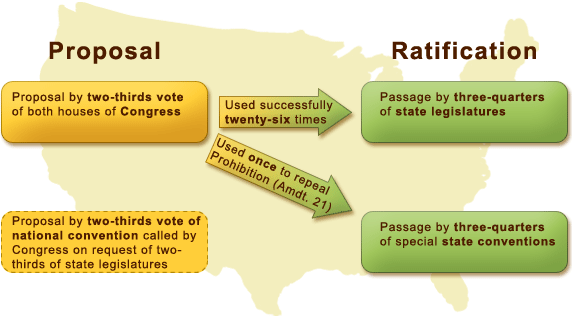
Amending the Constitution

A few months back the New Yorker ran piece explaining how close the Republican Party is to controlling a enough state legislatures needed to call a constitutional convention of sorts. As the above diagram illustrates, there are two ways to start the process of amending the constitution. Normally, the process is started by two-thirds of the Congress (both houses!) agreeing on text. The last time this happened, to the best of my knowledge, was in 1978 when Congress passed the District of Columbia Voting Rights Amendment, which would have given D.C. full representation in Congress. Only 16 states voted in favor of the amendment.

Other than that, the closest Congress has come recently to sending a proposed amendment to the states was the Flag Desecration Amendment, which would have allowed for states to punish people who burned the American flag, overturning two Supreme Court decisions stating that individuals have a free speech right to do so. The measure passed the two-thirds threshold in the House but fell one vote short in the Senate.

The New Yorker piece notes, with alarm, that the Republican Party is close to having control of two-thirds of the state legislatures, which could result in a constitutional amendment being offered via the second method above, something that, to the best of my knowledge, has never happened before. The article notes that while a constitutional convention would most likely be called only to propose a so-called Balanced Budget Amendment, things could move in a different direction once the delegates met:
The original Constitutional Convention was intended only to recommend changes to the Articles of Confederation, not to do away with them, but the delegates literally took the law into their own hands and drafted a new document. It’s easy to imagine that an Article V convention would find it difficult to limit its agenda to the technicalities of budget finance. Abortion, the most divisive social issue of the past forty years, has insinuated itself into nearly every discussion of nominees for the Supreme Court. Could a gathering intoxicated by the possibility of imposing permanent change resist the urge to achieve by amendment what decades of lobbying, protesting, and the cultivation of sympathetic judicial candidates could not? Similarly, as the battle over immigration has intensified, conservatives have toyed with the idea of ending birthright citizenship, currently guaranteed by the Fourteenth Amendment. The allure of bypassing legislative stalemate on that issue might also prove tempting.
In the age of Trump, it is easy to conjure up images of American democracy as we know it seeking to exist (as anyone who has heard me discuss the constitution know, I don't believe this is a possibility). This article lays out a scenario for the dismantling of sacred rights. I suppose if Trump can be elected President, anything is possible. 

13 January 2017

How the Next Supreme Court Justice Will be Chosen

It is expected that one of the first official acts that will be undertaken by President Trump is the appointment of a U.S. Supreme Court Justice. The National Constitution Center has a very informative piece up on its website about how this process will play out.

07 December 2016

England Considering Raising Small Claims Court Limits

Students in my introduction to common law courses learn that England has a multi-tiered system of civil procedure. At the one extreme are the complex cases where the parties have the ability to undertake all kinds of pre-trial preparation. At the other end is are the small claims cases where the amount is so small that it makes no sense to hire a solicitor. In between is a tier where the process is probably too complex for a claimant or defendant to appear without representation.

At the moment, personal injury claims with potential damages of more than £1,000 are barred from the small claims process and must be heard using the more expensive and complex middle tier process. Recently, the Ministry of Justice announced that it would like to raise the limit to £5,000. This would result in more cases being heard using the small claims process, a process that normally does not require parties to hire legal representatives. As the Law Society Gazette points out, The Law Society is none too pleased about this development, claiming that it will result in courts becoming clogged and parties obtaining less for their injury than they otherwise would. Of course, solicitors also will lose some business.

Follow the link to the Law Society Gazette to obtain a better understanding of how this system works and what these changes might mean for parties.

29 November 2016

Judicial Review in UK News

Students in my Introduction to Common Law courses in Münster and Osnabrück eventually hear me struggle with explaining the concept of judicial review in England. This phrase is used in a much more narrow sense than it is in the United States, which results in this American struggling to clearly explain how it works. Well a recent case that is headed to the UK Supreme Court provides us with an excellent example of what judicial review is and how it works in England. The case involves a young woman living in Northern Ireland who wished to terminate her pregnancy. The wonderful blog Legal Cheek explains:
In 2012, A — who was 15-years-old at the time — fell pregnant, but was unable to obtain a termination in her home country because of its stringent anti-abortion laws. The Abortion Act 1967, s1 of which lays down the mechanism for a legal abortion, does not apply in Northern Ireland, meaning women can only legally access the procedure if her health is at serious risk. Women who have been raped cannot access abortions legally, nor can victims of incest or women carrying foetuses with fatal abnormalities. The appellant did manage to terminate her pregnancy by travelling to a private clinic in England at the cost of £900, but has now brought a judicial review against the Secretary of State for Health, Jeremy Hunt, on two grounds.
The grounds included: 1) a failure by the Executive to abide by its duty to order facilities in Northern Ireland to provide the woman with termination services and 2) a failure by the National Health Services to provide such services to women in Northern Ireland as provided by an Act of Parliament. Interestingly, the second claim is being brought under the European Convention of Human Rights.

In short, this case illustrates nicely the difference between an appeals court hearing an appeal and engaging in judicial review. An appeal involves questioning whether the lower court or government body made an improper decision under the law. Judicial review, on the other hand, asks whether the government acted improperly or failed to act when it was required to. The case will be heard soon by the UK Supreme Court.  

22 November 2016

The "Did Not Vote" Won

I came across this interesting map on Twitter a few days ago that really drives home the point about how pathetic voter participation is in the United States. The map looks at how many eligible voters there are in each state and then sorts the vote by people who voted for the various candidates and those who did not vote. In all but only handful of states the people who did not vote for President outnumber those who voted for a particular candidate. The map then awards the Electoral College votes to the "did not vote" category in each state where they outnumbered a particular candidate and comes out with a landslide victory for "Did Not Vote" in the Electoral College.

20 November 2016

$19 Million Spent By Outside Groups on Judicial Elections


How we select our judges in the United States is perhaps one of the things that surprises students in my introduction courses the most. Almost three quarters of the states in the United States place the names of judges on election ballots, and let the voters decide whether they should remain on the bench. Some do this using a process called retention, while others allow for open, competitive elections, just like any other elected office.

As is the norm in the United States, most people obtain their information about candidates for elected office via television commercials. These commercials are usually sponsored by the candidates themselves, but increasingly outside political action groups are funding commercials for the candidate of their choice. The same holds true for judicial elections. According to the Marshall Project, political action groups not directly affiliated with a political party or a candidate spent over $19 million on judicial elections this past election cycle.  The article goes on to note that this spending for the most part failed to unseat their intended targets. This, however, will likely not dissuade people from contributing to these efforts in the future.

Those interested in a amusing take on the idea of electing judges should watch the John Oliver piece above. Be warned, this is HBO, so the language might be a little rough.

18 November 2016

England Raises Maxmimum Age for Jury Service

News items in the Daily Mail don't usually catch my attention, but one from a few days ago did and will also be of interest to students in most of my courses. The headline: "Top age limit for jurors to rise by five years to 75 from next month - adding THREE MILLION people to the jury 'pool'" The article goes on to give some interesting facts:
It is thought the move to introduce a new upper age limit - first proposed in 2013 - could add an estimated three million eligible 70 to 75-year-olds to the overall jury 'pool', meaning the number rises by a tenth from around 31 million to 34 million.

Roughly 178,000 people in England and Wales undertake jury service each year. Officials estimate that between 3,000 and 6,000 of the average annual jury service number would be aged between 70 and 75 after the change.