The Establishment Clause of the U.S. Constitution, or least the way the Court has struggled with it, is not an easy concept for students to grasp. What makes it most confusing is that America is perceived as an über-religious country, and then students read about the wall of separation and are left totally confused. I assume most religious conservatives in America share their plight.
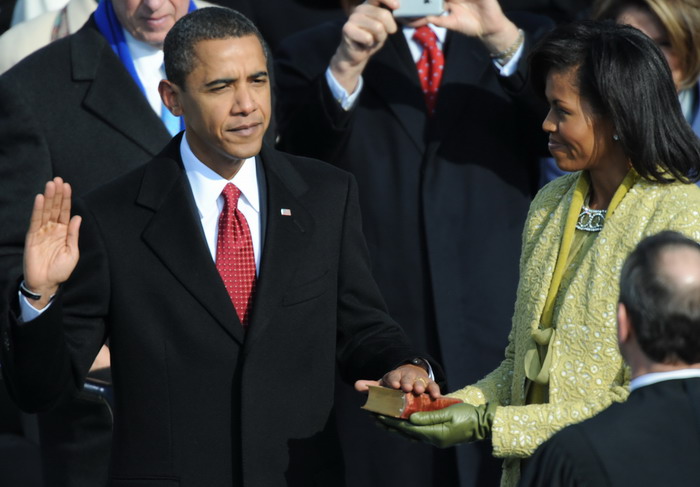
But if there really is this wall separating church and state in America, why are references to God seemingly everywhere: on money, in the national motto, in the pledge of allegiance, said by the President after almost every televised speech, as so on. Recently the U.S. Supreme Court was asked to consider the same question in the context of an Establishment Clause challenge to the taking of the Presidential oath whereby the Chief Justice finishes the oath by asking the soon-to-be President to repeat "so help me God."
Remarks and observations concerning American law and cultural studies as it relates to courses taken by students in the University of Osnabrück's and University of Münster's foreign law programs.
Matt LeMieux
Showing posts with label Religion. Show all posts
14 December 2009
Is Adultery a Crime?
Leaving aside the moral implications of my question, what I am really asking here is does the act of adultery violate a criminal law. At the turn of the century . . . the 19th century . . . all states had laws punishing adultery. The punishment ranged from flogging to imprisonment. But today no one talks, for instance, of charging Tiger Woods with a crime. But could we? Apparently, the answer is yes, at least in some states. The Associated Press has more.
28 January 2009
When Family Autonomy Goes Too Far
Students in my Introduction to American Law class recently learned that family law in the United States is primarily regulated by state law. I did, however, give some examples as to when federal law (or more specifically the federal constitution) comes into play in the area of family law. The primary example concerns a liberty interest that is sometimes referred to as familial relations. Put simply, there are some instances when the state, via family law, cannot interfere with the relationship between parents and children. But obviously this has its limits. A recent New York Times piece on parents who are being criminally charged after failing to provide their child with medical care led to her death illustrates the limits. The case concerns parents who believed that only God could heal their sick child. They are now claiming that using child neglect and endangerment laws against them violates their constitutional rights to freedom of religion. This sounds outlandish, but this area of the law is actually still somewhat unsettled in the United States, which is why this case is receiving a bit of attention. The Times piece is a must-read if you are interested in this topic.
02 December 2008
In God We Trust

or maybe I should say to God we give credit. At least that is what legislators in the State of Kentucky say must be part of the Kentucky Department of Office Security's annual report. According to the Associated Press:
The law that organized the Homeland Security office first lists Homeland Security's duty to recognize that government itself can't secure the state without God, even before mentioning other duties, which include distributing millions of dollars in federal grants and analyzing possible threats.This seems to raise the same question that I ask myself every time I see an athlete praise God after a sporting event. If both teams ask for God's help with winning, do members of the losing team blame God for the loss? In the instance above, if God gets credit for securing the State of Kentucky, might he be blamed should something terrible happen there? Probably not. Instead the blame will be placed at the feet of "abortionists" gays and the ACLU. (follow the link and see quote number one if you are unsure what this means).
23 June 2008
Puting the Cross on License Plates

The State of South Carolina will soon be offering a license plate to its drives with a Christian cross on it, as well as the words "I believe." Anyone who has been to the States might have noticed that one can find a variety of different license plates within a given state. While in Florida last year, I noticed license plates containing environmental themes ("protect our reefs" and "save the manatee"), sports themes (NASCAR, University of Florida, Florida State University) and family themes ("family first" or "family values"). click here for a complete list of Florida specialty license plates.
The question here isn't whether states can have specialty plates, but what happens when one of these specialty plates contains a message that may violate the Constitution. As students in both my classes this semester know, the First Amendment of the U.S. Constitution contains the Establish Clause, among other clauses. This clause has been interpreted by the Court to require some semblance of a separation of church and state. So when a state provides a license plate with an unmistakable Christian symbol on it, does this act violate the Establishment Clause? The courts will most surely be asked to decide this question in the near future.
09 June 2008
Interpreting State Constitutions
As has been noted on several occasions in American Constitutional Law class, an individual state may grant more rights to people under it's constitution than are available under the federal constitution. But there may also be instances where a state constitution places more limitations government. For instance, the United States Supreme Court has held the giving parents vouchers (money) to help pay for tuition charged by religious schools did not violate the Establishment Clause found in the First Amendment of the U.S. Constitution. But many states, including Arizona, have a clause in their constitution that specifically prohibits state money from being used in any manner related to religion. So it was no surprise that the Arizona Supreme Court recently ruled that school vouchers given out by the State of Arizona violated the Arizona constitution. So, to review, the U.S. Supreme Court said this practice does not violate the U.S. Constitution, but the Arizona Supreme Court said that it DID violate the Arizona constitution. Federalism in the U.S. isn't always easy to comprehend.
03 June 2007
Separation of Church and State
In our Constitutional Law class we will soon be discussing the religion clauses of the First Amendment. One of the more controversial interpretations of the First Amendment's Establishment Clause is that government and religion should be separate, or as Thomas Jefferson wrote, there should be "a wall separating church and state." The are many arguments in support of this interpretation of the Establishment Clause, but the one that is most convincing to me is that we should not allow government and religion to mix because America is a religiously diverse country and some religions will be given an advantage over others. For instance, if we allow prayer in public school, whose prayer should we allow? Christian? Jewish? Muslim? Hindu? If we simply allow the majority to decide then surely those practicing a minority religion will feel left out.A nice illustration of this is currently being debated in Indonesia, which is predominately Muslim, but also has majority Christian areas. Many areas within Indonesia base their laws upon the Koran, also known as Sharia law. For instance, in some parts of the country all women, even those who are not Muslim, must abide by the Sharia law dress code for women. In response to this, politicians in a Christian area of the country are proposing basing their laws on the Bible. But is this really the best way for a diverse country to operate? Is it preferable to have a patchwork of relgious based laws across the country? Or is the better solution to simply keep religion and government separate, as Thomas Jefferson proposed at the birth of the United States.
Subscribe to:
Posts (Atom)
