Matt LeMieux

Showing posts with label Introduction to US law. Show all posts

17 December 2017

Questioning of Federal Judge Appointees


Anyone interested in seeing how members of the Senate Judiciary Committee question people appointed by the President to fill lower federal court vacancies should check out this video. The five people being questioned are appointees from U.S. District Court Judge. As a trail judge, they will be responsible for ensuring that the parties are treated fairly and the trial operates according to well established procedural rules.

In class I have mentioned that while the qualifications to be a federal judge are not spelled out in the Constitution, the Senate usually takes its constitutional duty of "advice and consent" rather seriously. The Senator asking the questions in this video is a Republican. Thus, he is asking questions of people who were nominated by a Republican President to be a federal court judge. Recently, the Chair of the Senate Judicial Committee, also a Republican, expressed concern about some of President Trump's nominees for the federal judiciary

07 December 2017

Old School Cease and Desist

Students taking my common law courses recently heard me talk about the various steps involved in getting a case heard before the court. As I told students, before parties even contemplate filing a lawsuit in the United States, informal communication will sometimes take place in the form of demand or cease and desist letters. It is rather unusual that the topic of cease and desist letters is covered by the media, and even more unusual for the coverage of such to be entertaining. But every once in a while the stars line up and such coverage occurs just when I am discussing the topic in class.

The American website Digg.com has more:
Modist Brewing Company, a microbrewer based in Minneapolis, Minnesota, just released a Double IPA called "Dilly Dilly," referencing a nonsense phrase coined and trademarked for a series of Bud Light ads. The Bud Light people stepped in with their warning — a decree from a King's messenger:

22 November 2017

When Judges Are Called for Jury Duty

Recently the Chief Justice of the Kansas Supreme Court was called for jury. The Topeka Capital-Journal reports that when the judge:
reported for duty on Tuesday, he came to court expecting to serve. He checked in at the jury coordinator’s office, watched the orientation film about jury duty, then waited for the trial to start. . . . However, the defendant in what was expected to be a one- or two-day trial pleaded guilty to felony theft, and a jury wasn’t needed. Nuss (the Chief Justice) was one of 52 Shawnee County residents summoned for duty in that pool of prospective jurors.
According to the Capital-Journal, this was actually the third time the Chief Justice has been called to jury duty, however, the first two did not result in him actually needing to serve.

20 November 2017

Judicial Qualifications

As students in my courses have learned, the process for filling vacancies in the U.S. federal court system involves the President nominating a candidate and a majority of the Senate voting to confirm that person. As I have also mentioned, the constitution is silent as to what qualifications one needs to be a judge. A cynic might say that the only qualification is catch the President's eye and convince a majority of the Senate you can be a judge. While the Senate usually takes its job of ensuring that candidates for these positions are qualified, politics sometimes gets in the way. And so it seems with one of President Trump's recent nominees for U.S. District Court Judge

The Los Angeles Times recently had a scathing editorial taking the President and Senate to task for seriously considering a 36 years old candidate who "has practiced law for only a few years and never tried a case." Read the rest to get a taste of how the qualifications of judicial nominee can be become quite contentious and why being cynical about the process is sometimes warranted.

17 November 2017

Rarely Discussed Process Being Discussed

Just when you thought that American politics couldn't get more dysfunctional, or as one commentator likes to say, more stupid, along comes a special election in Alabama to fill one of its seats left vacant by Jeff Sessions becoming Attorney General. The election was already "special" in that it features a candidate who had already been removed from sitting on the Alabama Supreme Court because he refused to follow the U.S. Constitution. Now this candidate is accused of dating minors when he was a 30 year old government lawyers. As more and more women come forward telling the same story about this candidate, and as polls in Alabama seem to indicate that the voters of Alabama might still elect him (!!), leaders in the United States Senate have been openly saying they will not allow this candidate to sit in the Senate should he be elected.

Can do they do that, you might ask? Students in my American Constitutional Law course should know the answer to this, but I'd be surprised if they do as we spend all of about five seconds talking about this topic. Early on I tell students that the Constitution gives both the Senate and House the power to make internal rules and punish their own. Punishment can include removal.

As a recent New York Times article correctly points out, while the Senate cannot refuse to accept this candidate should he be elected, it most surely can vote to remove him.

16 November 2017

Criminal Case Against U.S. Senator Might be Stalled

An article a few days ago on NJ.com had a headline reading "Defense in Menendez case pushes for mistrial as jurors fail to reach verdict." Oh, where to begin. So far all of my groups studying common law have been exposed in one way or another to the use of juries. Coming up will be a discussion on "mistrials" and "hung juries." If you want a preview of this topic, do yourself a favor and check out the article from which the headline is taken.

UPDATE: last night, after speaking individually to each juror, the judge declare a mistrial because the jury could not reach a verdict.

14 November 2017

Unanimous Jury Issue Might be Heading to Court

Most of our knowledge about juries comes from popular culture where more often than not it said that in order to convict someone, the jury must be unanimous. As it turns out, this is not always the case in the United States, as two states allow for 10-2 jury convictions. The Washington Post recently ran an Op-Ed that is not only critical of these two states, but makes the argument that their policy regarding unanimous decisions has a racist history:
Louisiana and Oregon are not often thought of in the same vein. But on the issue of non-unanimous juries, they are kindred spirits. 
In these two states, the prosecutor needs to persuade only 10 of 12 jurors for a felony conviction that does not involve the death penalty. All other states require unanimous jury decisions in felony cases — as does the federal system, including federal courts in Louisiana and Oregon.
These jury systems are largely unnoticed vestiges of white supremacy and oppression in our legal system. The Supreme Court now has the chance to accept a case that could end the use of non-unanimous juries in criminal cases. It should take this chance.
 The rest of the piece is worth a look.

31 October 2017

No Lawyers Necessary

A great piece over at The Conversation reminds us that having a lawyer is a requirement for accessing the court system in the United States, it is increasingly necessary:
Eighty percent of state criminal defendants cannot afford to pay for a lawyer, and only those who are actually incarcerated are constitutionally entitled to appointed counsel. Many people facing misdemeanor charges can, if convicted, be subjected to significant fines and fees, or face the loss of benefits (including housing) or deportation. Yet, they have no right to an attorney, and those who cannot afford a lawyer will go without one.
Unlike in the criminal context, there’s no federal constitutional right to counsel in civil cases. Civil cases can involve a range of critical issues, including housing, public benefits, child custody and domestic violence. And while some civil litigants may be entitled to counsel in certain jurisdictions, in most of these cases, people who cannot afford a lawyer will be forced to go it alone. Doing so may mean that they fail to make it through the process, have their case dismissed or lose what otherwise would have been a winning case.
The article goes on to cite statistics like: "In some states, as many as 80 to 90 percent of litigants are unrepresented, even though their opponent has a lawyer.

Before working for the ACLU, I was employed for almost two years by the Legal Services Corporation, which represents low-income individuals in civil cases. We only had the resources to take a handful of the cases that came through our door, meaning that those we turned away had to maneuver through the court system on their own as a so-called pro-se litigant.

The United States prides itself on the idea that everyone has access to justice, and while in theory that is true because obtaining a lawyer is not technically required to access the courts, as this article points out, it is increasingly necessary in the face of courts who are hostile to so-called pro-se litigants.

As an aside, this is also an issue in England and Wales, and pointed out in this recent Guardian article.

10 October 2017

First Monday in October


Legal watchers in the United States know exactly what "the first Monday in October" means. This is the day on which each new term of the U.S. Supreme Court begins. But why the first Monday in October? The Constitution Daily blog explains.

17 July 2017

The Origins of the Term Gerrymander

Recently I have started discussing the topic of gerrymandering in my Constitutional Law courses. The term itself must sound funny to a non-native speaker. What on earth is a "gerrymander?" I suspect most native speakers also do not know the origin of this term and simply throw it around without ever wondering about this. A recent post by the National Constitutional Center explains that the "gerry" part of the term is linked to founding father and former Governor of Massachusetts Elbridge Gerry. Gov. Gerry notoriously pushed a plan to redraw the lines of the political districts within the state. Critics of the plan were quick to point out that one of the districts looked like a salamander, and a political cartoon (see above) coined his plan as "gerrymandering." The term has stuck ever since.  

29 June 2017

Executive Privilege: A Primer

The National Constitution Center recently posted a piece on Executive Privilege that is a must read for my students in Introduction to U.S. Law and Fundamentals of Constitutional Law. As students will remember, Executive Privilege allows the President and his advisers to keep their conversations private. Of course, like many of the things we have talked about in class concerning executive power, President Trump has made this once boring topic come to life. As the National Constitution Center writes:
Currently, the Trump administration has requested that a federal district court based in Detroit consider an executive privilege claim related to memos prepared by Trump campaign adviser Rudy Giuliani about an alleged Muslim ban – written before Trump became President. The request is under consideration.

27 June 2017

Breaking Presidential Ties

Here is a nice review for students in my Fundamentals of U.S. Constitutional Law and Introduction to U.S. Law courses. It touches on what happens when no one gets a majority of the votes in the Electoral College. If students understand the prior sentence, they are in good shape for the exam!

26 May 2017

The Strange Journey of the 27th Amendment

The Constitution Daily blog has piece it runs every year (at least a version of it) entitled "How a C-grade college term paper led to a constitutional amendment." Students in my constitutional law course have heard me say how difficult it is to amendment the U.S. Constitution. Since its ratification 228 years ago, the document has only been amended 27 times, 10 of which came a mere two years after the initial ratification. That means only 17 amendments in 226 years! The most recent amendment, as the article notes, actually was submitted for ratification over 226 years ago, but didn't obtain enough votes from the states until 1992. That's one long process. To find out what happened, take a look at the article above or watch this YouTube video. It's an interesting story.

24 May 2017

The Role of the Judiciary

On heels of President Trump's angry tweets about judges after his so-called Muslim Ban was struck down, Lyle Denniston at the Constitution Daily Blog couldn't hide his displeasure in a post entitled
"Analysis: A constitutional lesson for a new president." Denniston begins by quoting Chief Justice John Marshall:

"It is emphatically the province and duty of the judicial department to say what the law is.”


The quote is taken from the landmark Marbury v. Madison case, establishing the Court as the final interpreter of the Constitution, and it nicely sums up the constitutional role of the federal courts. The rest of the post is well worth a read, as it not only is aimed at giving the President a lessen concerning the role of the courts in the American system, it also serves as a lesson for students in my courses as well.

23 May 2017

Removing a Juror Who Relied on a "Higher Power"

A local Jacksonville, Florida news station recently reported that a U.S. District Court judge removed a juror who claimed she would rely on a "higher power" to help her decide the case. First Coast News reports:
A juror said he’d been told by "My Father in Heaven” that former Congresswoman Corrine Brown was not guilty in the federal case against her, according to a transcript released late Monday. “Did you say the words, ‘A higher being told me that Corrine Brown was not guilty on all charges?’” U.S. District Judge Timothy Corrigan asked Juror 13, according to the transcript.“No,” the juror responded. “I said the Holy Spirit told me.”
This conversation took place after the case was finished as the jury was about to deliberate. Fellow jurors who overhead the juror make a similar statement brought their concerns to the Judge's attention, which ultimately led to her removal form the case. It illustrates the power judges have to remove jurors in order to avoid potential irregularities in the trial.

22 May 2017

Removing the President

There is a thorough article in the Online version of Cicero entitled "Wird Trump gefeuert?" that students are encouraged to take a look at. Not only is this a good description in German of the various ways Trump can be removed (I gave you the English version in class), it also draws the correct conclusions about the politics involved in such a decision.

Juries and Racial Bias

The justice system itself is not immune to racism, so one would think that racism is also a problem when it comes to juries. But what legal impact does alleged racial bias on the part of jurors have on the outcome of a case? The U.S. Supreme Court recently answered this question by saying such bias potentially violates the constitutional rights of criminal defendants.

The real question before the Court involved the general rule that jury deliberations are confidential. But in this case a majority of the Supreme Court ruled that charges of racial bias might open the door to break this confidentiality rule. Writing for the majority, Justice Kennedy said "A constitutional rule that racial bias in the justice system must be addressed — including, in some instances, after the verdict has been entered — is necessary to prevent a systemic loss of confidence in jury verdicts." 

21 May 2017

How Presidents Shape the Judiciary

Good reminder in Die Zeit about how Presidents can shape the judicial branch. A few things to keep in mind. Presidents still need the consent of the Senate to do this, which is not always a given when the Senate is controlled by the opposition party. Also Trump is no different than his predecessors in wanting to shape the Judiciary. What's different is Trump doesn't really seem to care about this and instead is using it as an incentive to get conservatives to support him.

15 May 2017

Amending the Constitution

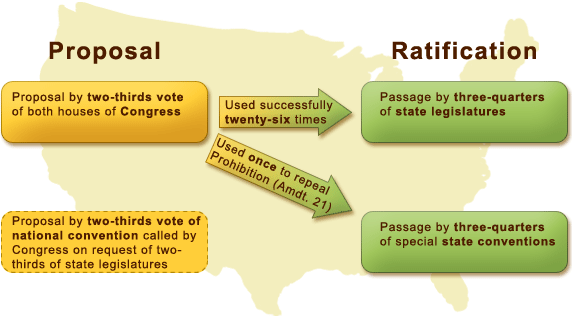
A few months back the New Yorker ran piece explaining how close the Republican Party is to controlling a enough state legislatures needed to call a constitutional convention of sorts. As the above diagram illustrates, there are two ways to start the process of amending the constitution. Normally, the process is started by two-thirds of the Congress (both houses!) agreeing on text. The last time this happened, to the best of my knowledge, was in 1978 when Congress passed the District of Columbia Voting Rights Amendment, which would have given D.C. full representation in Congress. Only 16 states voted in favor of the amendment.

Other than that, the closest Congress has come recently to sending a proposed amendment to the states was the Flag Desecration Amendment, which would have allowed for states to punish people who burned the American flag, overturning two Supreme Court decisions stating that individuals have a free speech right to do so. The measure passed the two-thirds threshold in the House but fell one vote short in the Senate.

The New Yorker piece notes, with alarm, that the Republican Party is close to having control of two-thirds of the state legislatures, which could result in a constitutional amendment being offered via the second method above, something that, to the best of my knowledge, has never happened before. The article notes that while a constitutional convention would most likely be called only to propose a so-called Balanced Budget Amendment, things could move in a different direction once the delegates met:
The original Constitutional Convention was intended only to recommend changes to the Articles of Confederation, not to do away with them, but the delegates literally took the law into their own hands and drafted a new document. It’s easy to imagine that an Article V convention would find it difficult to limit its agenda to the technicalities of budget finance. Abortion, the most divisive social issue of the past forty years, has insinuated itself into nearly every discussion of nominees for the Supreme Court. Could a gathering intoxicated by the possibility of imposing permanent change resist the urge to achieve by amendment what decades of lobbying, protesting, and the cultivation of sympathetic judicial candidates could not? Similarly, as the battle over immigration has intensified, conservatives have toyed with the idea of ending birthright citizenship, currently guaranteed by the Fourteenth Amendment. The allure of bypassing legislative stalemate on that issue might also prove tempting.
In the age of Trump, it is easy to conjure up images of American democracy as we know it seeking to exist (as anyone who has heard me discuss the constitution know, I don't believe this is a possibility). This article lays out a scenario for the dismantling of sacred rights. I suppose if Trump can be elected President, anything is possible. 

12 May 2017

Investigating Trump

Stefan Kornelius had a great piece in the SZ yesterday about how President Trump is threatening the rule of law in America. Deep into the piece Kornelius writes:
Sollte Trump die verwegene Idee verfolgt haben, mit dem Rauswurf die Russland-Ermittlungen beenden zu können, so hat er nun das Gegenteil erreicht. Selbst wenn der Kongress keinen Sonderermittler durchsetzen kann - das entsprechende Gesetz ist 1999 ausgelaufen, ohne erneuert worden zu sein -, so ist der Appetit an den Ermittlungen jetzt erst so richtig geweckt. Trump mag die Aufklärung verzögern, aber er kann nicht verhindern, dass seine allemal schwache Gefolgschaft im Kongress weiter schwindet und die dünne Mehrheit der Republikaner im Senat bröckelt. Amerika ist eine starke Demokratie, die auch ein Trump nicht so einfach ins Wanken bringen kann.
This is exactly right. If it becomes obvious that Trump is trying to impede a legitimate investigation, Congress will act, even if it is controlled by Republicans. The Republicans might want to support Trump, but they also don't want to lose their seats when they are up for re-election in 2018. They will if they are seen to be aiding a President who is trying to obstruct justice.

As an aside, students in my Constitutional law class are getting a real time lesson in how the President can be investigated. Take a look at the slides again from last week to have a fuller understanding of what Kornelius means in the quoted paragraph above.