Showing posts with label Freedom of Speech. Show all posts
Showing posts with label Freedom of Speech. Show all posts
09 January 2018
Flag Burning in the News
After recent protests in Berlin where a pro-Palestinian group burned homemade Israeli flags, calls for a change in the law regarding flag burning became louder than usual. Students are encouraged to draw comparisons to how the U.S. Surpeme Court has handled this issue and consider how they would react to these calls.

08 January 2018
Prior Restraint in the News

03 January 2018
Restricting Indecent Trademarks: Not So Easy
Near the end of my lecture on freedom of speech, I touch upon the idea of whether indecent speech is less protected. My conclusion, as students might recall, is that indecent speech is basically fully protected, but there are certain circumstances where it's protection is limited (in schools and on public airwaves for example). A recent case handed down by the Court of Appeals for the Federal Circuit (one of the two federal courts of appeals located in Washington D.C.) illustrates why I think indecent speech generally received full First Amendment protection. To be clear, many others take this view as well.
The Hollywood Reporter helps us out here:
The Hollywood Reporter helps us out here:
Barring trademarks that include immoral or scandalous language is an unconstitutional restriction of free speech, the United States Court of Appeals for the Federal Circuit ruled Friday.
Eric Brunetti founded the fuct clothing brand in the 1990s, but decades later was denied a trademark for the label because the U.S. Patent and Trademark Office found it violated the Lanham Act's ban on immoral or scandalous matter.Here it might be useful to point out that according to the Urban Dictionary, the word "fuct" is the past tense of "fuck" in urban slang. The Reporter goes on:
Brunetti then took his case to federal court, arguing that fuct isn't vulgar — but, even if it was, barring immoral marks is unconstitutional.
The federal circuit agreed with him on the second argument — which wouldn't have been possible until June, when the U.S. Supreme Court overturned case law that held restricting someone's right to have a trademark didn't necessarily restrict that person's free speech. In that case, involving rock band The Slants, the court found the USPTO’s denial of trademarks had a chilling effect on speech.
While the court finds the use of vulgar trademarks in commerce discomforting, it acknowledges that similarly offensive images and words have secured copyright protection.In short, the courts have consistently held that even "discomforting" words enjoy full First Amendment protection.
16 December 2016
Nothing Obscene About Giving the Finger
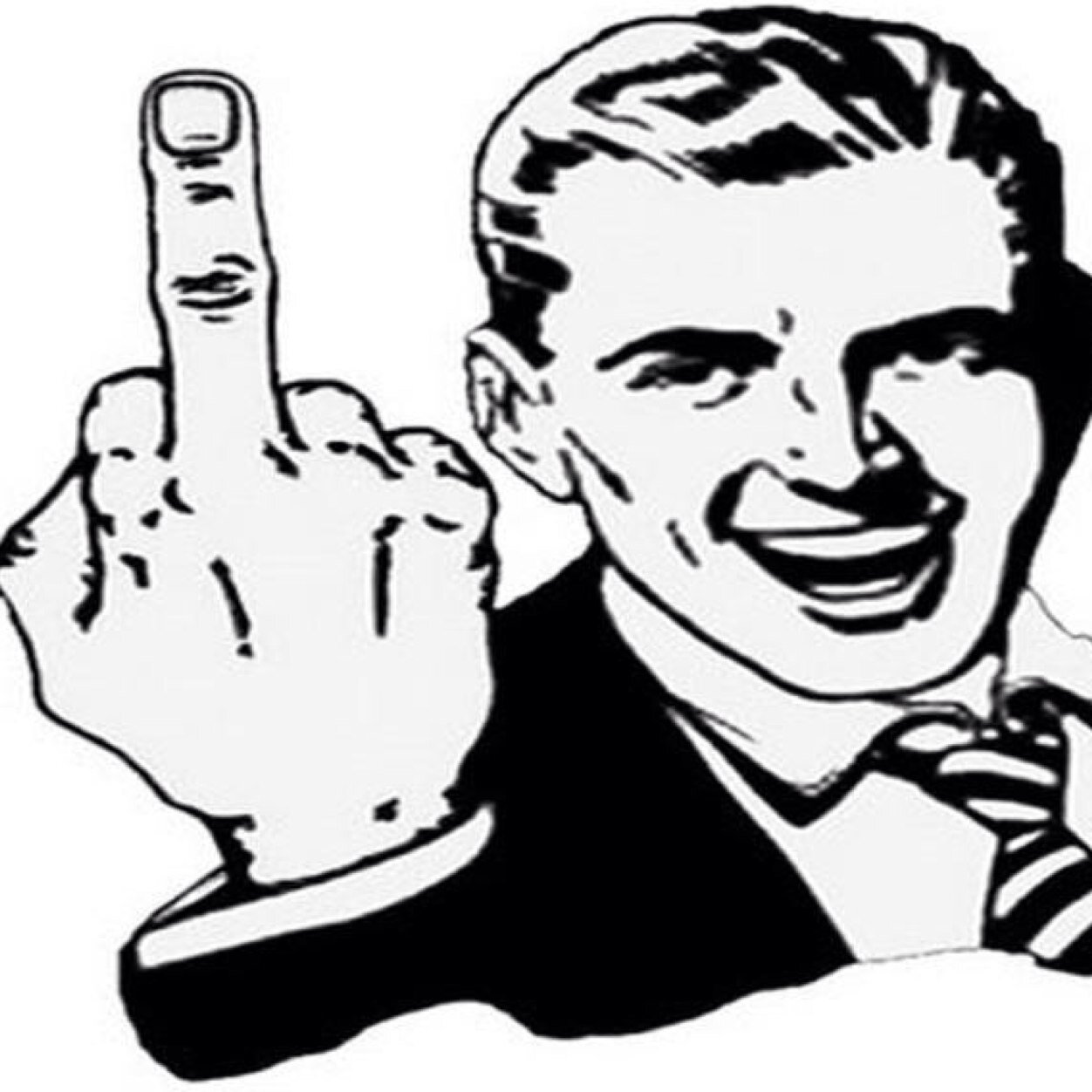
involves facts that would be funny if they weren’t tragic in the everyday sense of the term. Jason Waugaman was dropping off his children, 6 and 7, at the apartment building of his ex-wife, Kacie Boeshore. She came down to meet them in the parking lot; Waugaman was kissing the kids goodbye.
According to Boeshore’s testimony, as she walked away with the kids, Waugaman said something she couldn’t hear. She turned around, walked back and stood several feet in front of his car demanding to know what he’d said. Instead, Waugaman drove off, giving his ex the finger and (Boeshore testified) narrowly missing her.
Police in Hampton Township, Pennsylvania, near Pittsburgh, charged Waugaman with reckless endangerment for the driving and disorderly conduct for the gesture. A judge acquitted Waugaman of the first, more serious charge, but found him guilty of disorderly conduct under a state statute that makes it a crime to intentionally “cause public inconvenience, annoyance or alarm” by using “obscene language” or an “obscene gesture.”Students are encourage to read the rest of the article as it clearly explains why courts are so reluctant to categorize something as non-speech. Students in my constitutional law class will know what I am talking about here (at least I hope they do).
06 November 2016
The Candidates and the Constitution

12 June 2012
Not Again
I touch upon freedom of speech in several of my courses. When I do, I always like to point out that even offensive speech like swearing or flipping someone the bird is protected speech under the U.S. Constitution's First Amendment. I also like to point out that not a year goes by that I fail to see some news article about some city who has tried to punish someone for swearing in public. And right on cue comes an Associated Press piece about a small town in Massachusetts who just passed a local ordinance banning "loud, profanity-laden language." Incredibly, or maybe not, I wrote a similar post a year and one day ago about another local government punishing someone for swearing.
11 June 2011
When Will They Learn?

Hardly month goes by without the news reporting some case of a person being arrested and charged with a crime for swearing in public. Time and time again the courts throw these cases out on the basis of the First Amendment's free speech protection. It makes me wonder whether prosecutors have ever read the Constitution. This recent case out of Arizona is a nice example.
27 October 2009
Still On The Books
Fresh on the heels of our discussion in my course "The Law and Social Change" comes this piece from the First Amendment Center in the United States:
Watch your language out there, because profanity and blasphemy could lead to criminal charges. We might hope that First Amendment-protected free speech lets us utter profanities, blasphemies and other choice phrases that occasionally slip from our intemperate tongues. After all, the U.S. Supreme Court protected a man who wore a jacket into a Los Angeles County Courthouse bearing the words "Fuck the Draft." That led to the famous Cohen v. California (1971) ruling in which Justice John Marshall Harlan — a conservative during the Warren Court years — uttered a phrase that has become First Amendment lore: "One man's vulgarity is another's lyric." But hold on. Yes, in a free society adult citizens outside of special contexts (jobs, military, school) can speak their minds in the open air. But if you think old laws punishing profanity and blasphemy no longer exist, you're wrong — a surprising number of state laws still prohibit such speech. Even though the laws are rarely enforced, they are still on the books.You can read more here.
19 June 2009
Commercial Speech
Just how much protection does commercial speech have under the First Amendment? That is the question that is being raised after Congress recently passed a law prohibiting tobacco advertising within 1000 feet (304 meters) of schools. The law contains other speech restrictions as well. Wednesday's New York Times has an interesting piece on the legislation, which President Obama says he will sign, and the constitutional issues. As the Times points out:
Commercial free speech is not an absolute right, legal experts say. There are clear limits, for instance, on false advertising and on promotion of illegal activity. The issue grows more complicated if the advertising is both truthful and concerns a legal activity, like smoking by adults.The American Civil Liberties Union (ACLU) has also taken issue with the law saying that the legislation’s limits on commercial speech are broader than needed to accomplish the goal of reducing under-age smoking, i.e. the law is not narrowly tailored.
The Supreme Court in 1980 said such speech can be restricted only if it would directly advance a “substantial government interest” and the regulation was “narrowly tailored” to fit the interest. In the case of the new tobacco law, Congress specifically defined the government interest as a reduction in youth smoking.
But the tobacco industry denies that any of its advertising is aimed at young people.
11 May 2009
Banning the Flag

Can a public high school prohibit students from wearing T-shirts bearing the Confederate Flag? According to the Sixth Circuit Court of Appeals, the answer is yes. The court's decision, which is relatively easy reading, can be found here.
14 December 2008
Student Free Speech
A few weeks ago in my Debating Controversial Court Cases class, we had a lively discussion about the Tinker v. Des Moines case and whether students should have free speech rights in schools. As I mentioned in class, it seems like the Courts deal with this issue often as they struggle to balance the free speech rights of students with the interest of schools to keep order and educate students. A very interesting case was recently argued before the Third Circuit Court of Appeals. The Pittsburgh Post-Gazette reports:
What began as a lowbrow parody of a high school principal goes before a federal appeals court this week.Seems hard to believe that schools could possibly punish students for speech they engage in outside of school, but the Internet has truly changed the nature of speech. The Philadelphia Enquirer has more.
The case of Justin Layshock, who lanced his principal with an unflattering Internet "profile" created on a home computer, has become a battleground pitting Pennsylvania school administrators against groups that defend free-speech rights.
The 3rd U.S. Circuit Court of Appeals in Philadelphia will hear arguments from each side Wednesday.
Mr. Layshock used his grandmother's computer in December 2005 to create a fictitious profile of Hickory High School Principal Eric Trosch. Mr. Layshock, then a high school senior, made fun of the principal's bulk and implied that he smoked marijuana. Mr. Layshock posted the profile on the Internet social site Myspace.com.
Angered, Mr. Trosch and administrators of the Hermitage School District in Mercer County suspended Mr. Layshock from school for 10 days. After that, they placed him in an "alternative" education program that Mr. Layshock considered inferior.
18 June 2008
What Free Speech?
A few weeks ago 34 demonstrators were convicted of violating a law that prohibits holding demonstrations on the grounds of the U.S. Supreme Court. The question this obliviously raises is doesn't such a law violate the First Amendment right to free speech? The answer is probably not. Our discussion in class concerning freedom of speech has dealt mostly with something called "traditional public forums". These generally include streets, sidewalks and public parks. People have an almost unlimited right to engage in speech in this type of forum. But the courts have uniformly held that not all government property can be considered a traditional public forum. In fact, most government property is not considered a public forum and thus speech on this property can be regulated far easier.
Why make a distinction between a traditional public forum and other government property? Generally because the Courts have been sympathetic to the government's position that allowing speech on all government property in any manner would interfere with workings of the government. Imagine if the government had to allow protesters onto military bases or into prisons. Clearly, this kind of expressive activity would interfere with the ability of government to carry out it's mission, whatever that mission might be on the property in question. For purposes of this class, students don't need to know this distinction, but I hope it helps explain why these protesters, who entered the grounds of the Supreme Court, were arrested.
Why make a distinction between a traditional public forum and other government property? Generally because the Courts have been sympathetic to the government's position that allowing speech on all government property in any manner would interfere with workings of the government. Imagine if the government had to allow protesters onto military bases or into prisons. Clearly, this kind of expressive activity would interfere with the ability of government to carry out it's mission, whatever that mission might be on the property in question. For purposes of this class, students don't need to know this distinction, but I hope it helps explain why these protesters, who entered the grounds of the Supreme Court, were arrested.
16 June 2008
Establishing Obscenity
The Tampa Tribune has a nice piece, which tries to explain how obscenity laws in the United States are enforced. The title of the article, Standards Of Obscenity Are Murky, says it all. As we discussed in Con Law class last week, trying to spot this form of non-speech is not easy. Unfortunately for a pornographer who calls himself Max Hardcore, a jury in Tampa recently was able to weed through this murky area of the law and find his films to be obscene. Which means Mr. Hardcore will soon be serving hard time for violating obscenity laws.
23 November 2007
Press Freedom Revisited
 A few weeks ago, I posted a piece about press freedom in Germany and the rest of Europe. Obviously, press freedom is a universal issue that impacts every country in some manner or another. In the U.S., there has been an ongoing discussion about the limits of press freedom. Americans were recently reminded of this debate when a video blogger was put in prison for refusing to turn over video he used for a story he posted on his blog. This was on the heals of the case of Judith Miller, a New York Times reporter who was jailed for failing to reveal her source for a story a series of stories she wrote for the Times. In light of these recent high profile cases, academics in America are calling for the Courts to revisit the U.S. Supreme Court's decision in Branzburg v. Hayes, holding that reporters cannot use the First Amendment's freedom of press right to refuse to cooperate with a criminal investigation.
24 June 2007
The Final Eight
Entering it's last week of 2006-2007 term, the United States Supreme Court still has eight cases left to decide. And as usual, they are some of the most controversial cases on the docket. Students in my Conversation and Presentation Skills class know that the court is trying to figure out whether a student can be punished for holding up a sign saying "Bong Hits for Jesus" at an event held outside of the school. This case has the potential of redefining how the court deals with the free speech rights of students. But some of the other cases left to decide are equally interesting. For instance, the Court must still determine whether schools can take race into account when assigning students to schools in a given school district. The practice has been used for decades to make sure there is some kind of racial balance in schools. As students in my Constitutional classes know, the issue how race classifications operate under the Equal Protection Clause has been controversial since the adoption of the 14th Amendment to the Constitution. Also still on the undecided list is a case dealing with the death penalty and mentally ill defendants, as well as the ability to bring Establishment Clause challenges, as the Court looks at what kind of "harm" one must show to be a plaintiff in a challenge based upon the Establishment Clause. The issues involved in these cases touch upon some of the most hotly debated issues in America, and many people are anxiously awaiting this last week of Court decisions.
13 June 2007
Symbols Aren't Always Speech
 American Constitutional Law students learn that symbols are also considered speech that is protected by the Constitution's First Amendment. But one must be careful when dealing with symbols, as a biker club in California recently found out. For symbols to be speech they must communicate a reasonably understandable message. What does this mean exactly? Well for starters the person wearing the symbol must intend the symbol to express a thought or idea. Second, a reasonable person must be able to at least remotely understand the message being expressed.
A recent case in California, we will call it the California biker case, dealt with a prohibition of motorcycle club insignia and gang colors at something called the Gilroy Garlic Fair. The bikers in question wore a club symbol (pictured above) showing a skull, wings and a top hat; and were forced to leave the fair for violating the fair's aforementioned policy. They sued claiming the club symbol was speech protected by the First Amendment. They lost because not even the members of the biker club could agree on what the symbol meant. The court reasoned that if the bikers themselves didn't know what message was being expressed by wearing the symbol then how could the symbol be speech.
07 January 2007
Santa's Butt Can Be Displayed
Well, it can be displayed on beer bottles at least, according the Maine Bureau of Liquor Enforcement. Last month I wrote about a First Amendment case in the State of Maine concerning a beer bottle label showing a cartoon of a bare-bottomed Santa. According the Associated Press, the State of Maine will allow bottles with this label to be sold in stores. State officials admitted that a Court would probably find that the labels are protected by the First Amendment's free speech provision.
04 December 2006
Santa's Butt Raises First Amendment Issue
 According to the Bangor News Daily, "The Maine Civil Liberties Union wants Santa’s Butt in beer coolers by Christmas." In fact, what they (the ACLU) appear to be fighting over is whether the State of Maine can stop a beer producer from selling a beer that bares Santa's bottom on the label (see picture to the left). American Constitutional Law students will learn that the courts generally take a rather broad view concerning what constitutes "free speech." When the government prohibits a beer producer from using a particular label does that violate the First Amendment's Freedom of Speech provision? Probably. In Missouri, where I worked for the ACLU before coming to Germany, my office worked on a similar case. In this instance the beer producer used reproductions of classic nude paintings on his labels. The State of Missouri refused to grant him a liquor license to sell his beer unless he changed the label. The government finally backed down when we pointed out that the "obscene" label was a reproduction of a famous painting that hangs in the Louvre in Paris.
Subscribe to:
Posts (Atom)