 One of several important cases argued before the U.S. Supreme Court this week involves whether states can require people to show a picture ID (driver's license, passport, any other government-issued identification card with a picture on it) before being allowed to vote. The arguments for strict voter ID rules deal with stopping voter fraud. The arguments against such strict rules focus on access to voting as a large segment of lower income people in the U.S. may have difficulty meeting a strict ID test (put another way, they may not have a picture ID). For more on this issue, I suggest taking a listen to this piece on National Public Radio and reading this article in the New York Times. I've never asked anyone before what voters in Germany have to show before they can vote?
10 January 2008
Voter ID
One of several important cases argued before the U.S. Supreme Court this week involves whether states can require people to show a picture ID (driver's license, passport, any other government-issued identification card with a picture on it) before being allowed to vote. The arguments for strict voter ID rules deal with stopping voter fraud. The arguments against such strict rules focus on access to voting as a large segment of lower income people in the U.S. may have difficulty meeting a strict ID test (put another way, they may not have a picture ID). For more on this issue, I suggest taking a listen to this piece on National Public Radio and reading this article in the New York Times. I've never asked anyone before what voters in Germany have to show before they can vote?

09 January 2008
Stare Decisis and the U.S. Supreme Court
Upon being introduced to common law, students quickly learn about the important role that precedent and stare decisis play. As students know, or should know, the U.S. Supreme Court is not bound by its own precedents. Or put another way, there is no vertical horizontal stare decisis at the highest level of the American federal judiciary system. In class we discussed several reasons why the Supreme Court may decide to overrule itself. However, the idea that the Court is not bound by its own decisions is often debated in the U.S.. Such a debate recently broke out within the Court itself. Earlier this week Justice Stephen Breyer wrote that the Court should always try to follow it's own past rulings, even if the rulings no longer make good law! Six other Justices signed onto this opinion. The two dissenters wrote that sometimes fairness requires past decisions to be overruled. Tony Mauro over at The Blog of Legal Times has a great post describing the recent spat over stare decisis among the Justices. It's worth a quick read.
15 December 2007
Christmas Break

I won't be posting anything during the Christmas break. I'll be posting again during the second week of January when classes resume.
14 December 2007
Gun Rights Go Before the Court
Cass Sunstein, one of America's preeminent legal scholars, had a great editorial piece in last Sunday's Boston Globe concerning what could be the most important Second Amendment case in the country's history. The Second Amendment, for those not familiar with the American Constitution, contains a provision that may or may not provide an unlimited right to own guns in America. Many Europeans are fascinated by the American "gun culture," but few have stopped to ask why owning a gun in America is so easy. The quick answer is the U.S. Constitution talks about gun ownership. Soon the U.S. Supreme Court will define, for the first time in many, many decades, what exactly the Constitution says concerning gun ownership. Prof. Sunstein's article is a must read if you want a basic understanding of what's at issue before the Court concerning this gun rights case.
07 December 2007
The Limits of Peremptory Challenges
Students on common law learn early on that one of the more interesting features of the common law legal system is the use of juries. How juries are selected varies greatly from one common law country to another, and arguably the American system of jury selection is the most confusing. In the U.S., the parties themselves have considerable control over the make-up of a jury through the use of something called peremptory challenges. Basically, such challenges allow lawyers to remove potential jurors for any reason . . . except for the wrong reason. So what is a wrong reason? Well, removing someone based solely upon their race is one, according the U.S. Supreme Court in the 1986 case of Kentucky v. Batson. This week the U.S. Supreme Court considered whether a prosecutor improperly excluded all black potential jurors from serving on a jury in a murder case because of their race. The reach of the Batson case has never really been totally clear, and now the Court appears to be ready to provide further guidance. The Christian Science Monitor has a nice summary of the case before the Court and how it could impact jury selection in the U.S.. It's worth a read.
03 December 2007
The Secret Circuit
As students in Common Law Legal System recently learned, the United States Court of Appeals is divided into 13 circuits. Eleven of the courts are divided regionally, leaving two court that we did not really discuss in class. The U.S. Court of Appeals for the Federal Circuit is one of these two courts, and definitely the one that even American-educated lawyers may not fully understand. The San Francisco Chronicle recently ran a review of the book The Secret Circuit, which does a nice job of quickly summarizing the book's main premise: what exactly does this court do? If you are interested in patent law and want to understand the U.S. Court of Appeals more fully, you may want to give this book review a quick read over.
28 November 2007
Using English Punctuation Correctly
 Another gem from wikiHow, this time a quick refresher on using English punctuation properly. Knowing when to use a period (or as the British say "full stop") or question mark is easy. But how about using a semi-colon, colon, or dash? Or the dreaded and often overused comma? This short refresher should help you with some common usage problems; so common that most native speakers could use a refresher or two every-so-often.
27 November 2007
The Jury System in Japan
 Japan is one of those mixed systems that uses a bit of common law, although it is modeled after the European civil system. Its criminal justice system is undergoing big changes that seek to introduce something that is uniquely common law: juries. Hailed as the "most significant change in its criminal justice system since the postwar American occupation," Japan will begin using juries in criminal trials sometime in 2009. But here's the catch. Traditionally, the Japanese are reluctant to express opinions in public, to argue with one another or to question authority. In short, many Japanese are dreading the idea of serving on a jury. The International Herald Tribune has more on this interesting experiment.
23 November 2007
Press Freedom Revisited
 A few weeks ago, I posted a piece about press freedom in Germany and the rest of Europe. Obviously, press freedom is a universal issue that impacts every country in some manner or another. In the U.S., there has been an ongoing discussion about the limits of press freedom. Americans were recently reminded of this debate when a video blogger was put in prison for refusing to turn over video he used for a story he posted on his blog. This was on the heals of the case of Judith Miller, a New York Times reporter who was jailed for failing to reveal her source for a story a series of stories she wrote for the Times. In light of these recent high profile cases, academics in America are calling for the Courts to revisit the U.S. Supreme Court's decision in Branzburg v. Hayes, holding that reporters cannot use the First Amendment's freedom of press right to refuse to cooperate with a criminal investigation.
21 November 2007
Court TV
 Jurists in both America and Great Britain are struggling with whether to allow television cameras into its highest courts. In the U.S., each state has dealt with this question differently; some letting camera into their courtrooms others not. But the federal courts still are a bit camera shy. Questions such as fairness to the parties and whether allowing cameras in will turn the court process into a circus are part of this often heated debate. In Britain, where the court system is undergoing enormous changes, especially at the very highest level with the creation of a new Supreme Court, the question is whether viewers should be allowed to watch Supreme Court proceedings on TV. Obviously, these proceedings are open to the public, i.e. one can go to the courtroom and watch it. Furthermore, other political proceedings are already televised in both Britain and the United States. But some judges aren't buying it. Recently, U.S. Supreme Court Chief Justice John Roberts expressed concern that the camera's in the courtroom would undermine the workings of the Court. However, in Britain it appears that many top judges have no trouble with having their work televised.
20 November 2007
Then v. Than
Knowing when to use "then" or "than" isn't one of the recurring problems I see in students' writing. Nevertheless, it's always helpful to receive a little refresher and the WikiHow How-to-Manual has a short little piece that may be of assistance.
13 November 2007
Policing Judges
As students of Common Law Legal System in Münster and Institutionen von Staat und Gesellschaft in Osnabrück learn, judges in common law countries, especially in the United States and England, are quite powerful. Many are appointed for life terms (in England, a life term means until the judge turns 70 years-old) and few ever face the threat of discipline, even for the most outrageous of acts. Every so often, however, one comes across a story about a judge who has gone too far. One such story surfaced this past week in Virginia, where a state court judge was removed from the bench for extreme behavior. In this particular case the judge had done things like decide a child custody case by flipping a coin (Münze werfen) and ask a female to take off her pants in court. It's rare that judges get disciplined. So rare that when they do, it's newsworthy.
07 November 2007
Judges for Sale

Many states in America select their judges through an open election process. Thus, judges run for the post of judge just as any other politician runs for office. The upside? Judges become accountable to voters. The downside, and there are many? Judges, like other politicians in America, become reliant on campaign contributions. There are two interesting pieces in yesterday's USA Today highlighting the importance of money in the process of electing judges. One piece, written by someone in support of trial lawyers giving campaign contributions to judges makes the argument that if big business interests are giving money to judges, trial lawyers have no choice but to match those contributions in the hope of being able to equally influence judges. A sad commentary on this method of choosing judges, really. The other piece, I think, nicely points out the flaws of this system. Both pieces provide a nice understanding of the problems with electing judges in America.
05 November 2007
Wallach: Waterboarding Used to Be a Crime
Students in Münster have the privilege of selecting from a wide range of elective courses during their final two semesters of the FFA. One class offered every winter semester is The Law of War, taught by U.S. Federal Judge Evan Wallach. I've sat in on this class before and I can tell you that it is both timely and fascinating. As a federal judge, Judge Wallach likely feels somewhat constrained as to what he can say about the current "war on terror" being conducted by the Bush Administration. That's what makes his opinion piece that appeared in yesterday's Washington Post extraordinary. As I wrote last week, the issue of whether an interrogation technique called waterboarding is torture has been the focus of the U.S. Attorney General nomination hearings currently taking place in Washington D.C.. Judge Wallach weighs in on this debate with an emphatic YES.
02 November 2007
Press Freedom at Risk . . . in Germany!
In American Constitutional Law we learn about the central role that freedom of the press has played in the development of the American constitutional democracy. It goes without saying that press freedom is essential to any democracy. Which is why some of the measures taken by governments after the September 11 attacks in America are troubling. Der Spiegel has an interesting article on how the German government is joining the ranks of countries who are jeopardizing press freedom as part of the "war on terror."
31 October 2007
Torture and the Appointment Process
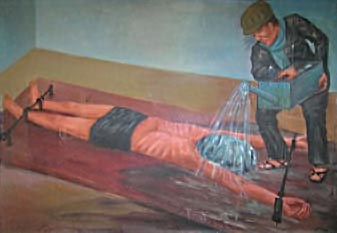 Students of American Constitutional Law learn that the U.S. President has the power to appoint the government's chief law enforcement officer, the Attorney General. Students also know that while the President has the power to appoint, he must also receive the consent of the United States Senate. This nomination process has been playing itself out in Washington D.C. over the past few weeks with President Bush's nominee for Attorney General, former federal judge Michael Mukasey (link to Spiegel article in German), appearing several times before a committee of Senators who are responsible for determining whether the nominee is "qualified." If you have been following this process, which is somewhat unlikely because the German media has not been following it, the central question concerning whether Judge Mukasey should be approved as the new AG is whether he believes something called waterboarding is torture. Seems odd that the process should boil down to this one question, and even odder that Judge Mukasey refuses to give his position on it. So what is waterboarding, you might ask? There was a great piece posted yesterday on the Foreign Policy Magazine blog quoting a person who is very familiar with how the waterboarding technique works. Follow the link below and judge for yourself whether this technique is torture and then ask yourself, why won't Judge Mukasey simply tell the Senators that this technique is indeed torture.
30 October 2007
The Joke's on Him
Did you hear the joke about the American lawyer who sued a dry cleaner for $54 million because the dry cleaner lost a pair of pants he brought in for $10.50 worth of alterations? Okay, as you probably know it was not a joke. An actual lawyer filed a real lawsuit in Washington D.C. earlier this year over missing pants. And yes the amount claimed in damages was $54 million. The lawsuit was rightfully dismissed, but the damage had been done. This case, and many others, keep the stereotype that many Germans have of Americans as being litigation happy alive and well. According to this stereotype, Americans will sue over just about anything (being served coffee that is "too hot," getting sick from smoking cigarettes or eating fast food, etc.). As I will point out in later posts, while the stereotype of Americans may be fair, it's not limited just to Americans. But back to the dry cleaner lawsuit. You may remember that the lawyer who filed the suit was also an administrative law judge. Well not for much longer, according to the Washington Post.
26 October 2007
More on el-Masri
Earlier this week I mentioned the case of Khaled el-Masri and how the U.S. Supreme Court has basically told him that he has no remedy for being wrongly abducted and held by U.S. authorities. Spiegel Online has a nice summary of the Court's decision in both German and English. It's worth read in whatever language you choose. The title of the piece Security Trumps Liberty says it all.
25 October 2007
Access to Justice

There is an access to justice problem in Canada, according the country's top judge. The issue, which is not unique to Canada, is the cost of going to court to seek redress for a wrong. According to a recent Toronto Star report, the cost of a routine three-day civil trial in Ontario is about $60,000, more than the median Canadian family income. The Star reports:
In a speech to the Canadian Bar Association yesterday, the country's top judge declared access to justice "a basic right" for Canadians, like education or health care. Although [Chief Justice Beverely] McLachlin has spoken out about the problem in the past, she sharpened her remarks yesterday and went further than she has before, citing what she described as an "increasingly urgent situation." The justice system risks losing the confidence of the public when "wealthy corporations," or the poor, who qualify for legal aid, have the means to use the court system, she said, noting that for "middle-class" Canadians, resolving a legal problem of any significance often requires taking out a second mortgage or draining their life savings.Others have argued that the problem is "money grubbing" lawyers who are charging excessive fees and lack principles.
24 October 2007
More to Come
And yet another semester begins.
Since I last wrote, the branches of the U.S. government have been struggling with how much power the government should have to intercept electronic communication of suspected terrorists. Yet, with the U.S. Supreme Court's recent refusal to hear the case of Khaled el-Masri (a case of particular interest to Germans because el-Masri is a German) and the President's refusal to turn over documents to Congress related to his powerful surveillance program, it appears that the struggle is far from over. But this is really a constitutional law question, and that was last semester. So what's new in the news concerning classes being held this semester? A lot! Over the course of this semester, I will be posting items related to our discussions in class as a way of illustrating that the theory we discuss in class is related to everyday current events taking place in common law countries. Check back regularly.
Since I last wrote, the branches of the U.S. government have been struggling with how much power the government should have to intercept electronic communication of suspected terrorists. Yet, with the U.S. Supreme Court's recent refusal to hear the case of Khaled el-Masri (a case of particular interest to Germans because el-Masri is a German) and the President's refusal to turn over documents to Congress related to his powerful surveillance program, it appears that the struggle is far from over. But this is really a constitutional law question, and that was last semester. So what's new in the news concerning classes being held this semester? A lot! Over the course of this semester, I will be posting items related to our discussions in class as a way of illustrating that the theory we discuss in class is related to everyday current events taking place in common law countries. Check back regularly.
Subscribe to:
Posts (Atom)