Matt LeMieux

30 May 2012

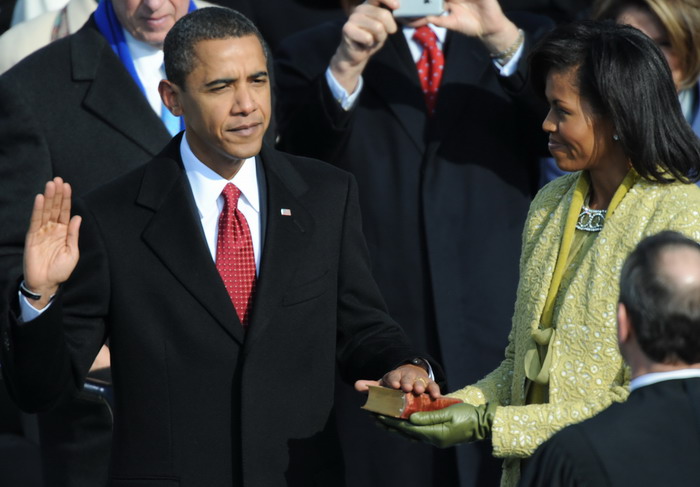
Supreme Court declines to hear 'So help me God' lawsuit

The Establishment Clause of the U.S. Constitution, or least the way the Court has struggled with it, is not an easy concept for students to grasp. What makes it most confusing is that America is perceived as an über-religious country, and then students read about the wall of separation and are left totally confused. I assume most religious conservatives in America share their plight.

But if there really is this wall separating church and state in America, why are references to God seemingly everywhere: on money, in the national motto, in the pledge of allegiance, said by the President after almost every televised speech, as so on. Recently the U.S. Supreme Court was asked to consider the same question in the context of an Establishment Clause challenge to the taking of the Presidential oath whereby the Chief Justice finishes the oath by asking the soon-to-be President to repeat "so help me God."

21 May 2012

Time for a Change?

Judicial elections in the State of Michigan have become some of the most expensive and downright nasty in the country. In a recent guest commentary published in the Detroit Free Press, several judges suggest it is time to fix a system where:
2010 candidates for the Michigan Supreme Court raised a total of $2.6 million. The political parties and state-based interest groups reported spending another $2.5 million. But data collected from the public files of state television broadcasters and cable systems showed that an additional $6.3 million was spent by the political parties and interest groups.
 Among the ideas suggested: scrap elections of judges!

16 May 2012

Do Away With Life Tenure?

The United States Constitution provides that judges "shall hold their Offices during good Behavior," which put another way means they are appointed for life. Is that a good idea? Not really claims one law professor.

15 May 2012

The Electoral College


Just in case my explanation of the way Americans choose their President was not clear, the Economist magazine has a very clear and concise one. The wonderful British accent of the narrator perhaps makes this explanation much more enjoyable to listen to than the one I provided in class.

11 May 2012

Jury Nullification. Unlawful?

One concept that seems to boggle the minds of students learning about the common law jury system is jury nullification. As students have learned, generally this is the principle whereby jurors may ignore the law when reaching their verdict if they believe in good conscience that applying the law strictly in a case would be unjust. As I repeatedly tell students, most jurors have no idea that they have such power, and no judge in his or her right mind would instruct the jury about this right.

But would happen if a private citizen tried to inform potential jurors of this right on their way into the courthouse? Could that be considered tampering with the judicial system? Illegal? It should be, argued New York prosecutors in a case they brought against an 80 year old retired professor who stood outside courthouses and distributed information to people about jury nullification. See here for the result.

04 May 2012

The Veepstakes

Yes, even the selection process for choosing a potential Vice-President of the United States has been boiled down to some catchy, made for TV tagline. Today we refer to the selection of a running mate for a presidential election as the "Veepstakes." Probably not what the founders had in mind when they created the position in Article II of the U.S. Constitution. Of course, as students in my American Constitutional Law course should already know, the founders set forth a different means for choosing a Vice-President than the one we have today. It was changed by the 12th Amendment.

But my real point here is not rehash what we learned in class, but to direct you to an in-depth article in Die Zeit about the current speculation as to who GOP presidential nominee Mitt Romney will select as his running mate. The article goes into why this choice may be important, and gives examples of how a bad choice can hurt the presidential candidate. A good, albeit long, read. At least its in German.

02 May 2012

Kiffen gegen die Staatskrise

Well actually "Kiffen gegen Schmerzen" is the name of a very informative Die Zeit article on California's medical marijuana law, although the article also notes that "Kiffen gegen die Staatskrise" may be equally applicable as the State of California receives over $1 billion dollars annually in tax revenue from the sale of medical pot. But I digress.

Students in any of my courses where we have discussed the American version of federalism should immediately know why this law is of interest to us. Students currently in my American Constitutional Law course will learn why next week. Either way, anyone interested in learning more about California's somewhat controversial law should take a look at the article in Die Zeit.

19 April 2012

Tweeting in the Courtroom

Does the use of Twitter by reporters to send out real-time reports of a courtroom proceeding endanger the rights of criminal defendants? According to one Chicago judge presiding over a highly publicised case, yes:
The judge in the Illinois case fears that feverish tweeting on smartphones could distract jurors and witnesses when testimony begins April 23.

"Tweeting takes away from the dignity of a courtroom," said Irv Miller, media liaison for Cook County Judge Charles Burns. "The judge doesn't want the trial to turn into a circus."
Burns is allowing reporters to bring cellphones and to send e-mails periodically, a notable concession in a state that has only recently announced it will begin experimenting with cameras in court and where cellphones are often barred from courtrooms altogether.
There's also an overflow courtroom where reporters can tweet freely. But there will be no audio or video of proceedings in the room, just live transcripts scrolling across a screen.
The issue extends beyond journalists to jurors, whose tweets have raised issues of their own across the country.
Last year, the Arkansas Supreme Court threw out a death row inmate's murder conviction after one juror tweeted during proceedings and another slept. Juror Randy Franco's tweets ranged from the philosophical to the mundane. One read, "The coffee sucks here." Less than an hour before the jury returned with a verdict, he tweeted, "It's all over."

11 January 2012

Using Google to Choose a Jury


The selection of a jury in the United States can be a complicated matter. In fact, it can at times look like a game. As more and more Americans make information about themselves available via social networks and the like, it was bound to happen sooner or later that clever lawyers would start conducting Google searches on prospective jurors. But is it OK for lawyers to google jurors during jury selection? Recently a New Jersey court answered the question affirmatively.

08 January 2012

Stille Nacht an Currywurst mit Grünkohl


I forgot to post this link to an article that Die Zeit ran before Christmas about the revival of interest in German culture among Americans. Since then I have read a few more articles in Die Zeit along the same lines. Anyway, my students studying American law may find this short article to be a nice diversion.

07 January 2012

Is A Disgraced Reporter Morally Fit to be A Lawyer?

This is the question currently in front of the California Supreme Court concerning the law license application of Stephen Glass, a former reporter for the New Republic magazine who was fired in the late 1990s after it was discovered that he fabricated most of the articles he wrote for the magazine. The San Francisco Chronicle has more on this fascinating question of how morally fit must one be to practice law in California.

07 December 2011

TV's in the Courtroom

Whether TV cameras should be allowed in the courtroom during hearings before the Supreme Court (both UK and US) has been a hot topic in both America and England as of late. In America, it appears that Congress is trying to pass a law that would require the high court to televise its hearings. But can Congress really force the Court? A very good article in the Christian Science Monitor asks this question.

20 November 2011

What They Don't Teach in Law Schools: Lawyering

The New York Times ran a piece this weekend with the above headline. This is a nice addition to our discussion in class (except for my Introduction to English Law course) about becoming a lawyer in the United States.

14 November 2011

How Powerful is the Federal Government?

As I mentioned last week in my Introduction to American Law course, questions concerning federalism in the United States are really now questions about how powerful the federal government can be. The New York Times ran a great piece this past weekend about this question of government power in the context of President Obama's effort to provide all Americans with health care. Give it a read and see if you can follow the arguments being made.

08 November 2011

Juries in the Age of Facebook

The Chicago Tribune recently ran a fascinating piece about whether a juror's blog postings impacted the fairness of a trial.

Judges have long instructed jurors not to talk about their jury service with anyone, including fellow jurors, and to avoid reading newspaper stories about trials. The fear is that jurors might develop a bias from information that's not been admitted in court. The right to an impartial jury is one of the principles of the American justice system.

But that right is threatened in a digital age when people post personal thoughts onto the Internet, whether on a blog or social networking sites such as Facebook and Twitter. It's also become second nature to satisfy curiosities by searching for immediate answers on the Internet.

The article goes on to discuss issues like jurors using Google Street View to visit the scene of a crime, something they are physically prohibited from doing, but virtually? It gives an example of a murder conviction being overturned because a juror consulted Wikipedia as part of the deliberation process. The questions raised in this article are numerous and important!

05 November 2011

Too Much Independence?


The main purpose of the 2005 constitutional reforms in the United Kingdom, which created a new Supreme Court, was to increase the independence of the judiciary. But now some three years into this constitutional experiment, some are questioning whether the Court has become too independent. The Guardian has more.

18 June 2011

Finding a Rational Basis to Prohibit Gay Marriage

The struggle of gays and lesbians to obtain full marriage rights is now a legal battle being fought in the courts. The questions facing the court are numerous and all grounded in the U.S. Constitution. For instance, the U.S. Supreme Court has recognized an implied constitutional right to marry. So does this also apply to gays and lesbians. So far the courts have said no. Does prohibiting gays and lesbians from marrying violate the Equal Protection Clause? Well, it depends how you analyze it. Under current Supreme Court precedent, the question must be analyzed using the Rational Basis Test. Under this test the plaintiff must prove that the government does not have a legitimate interest in passing the law and/or the means used to achieve the government interest are not rationally related to the interest itself. The primary argument used by opponents of gay marriage is that the government has a legitimate interest in encourages only those partnerships where procreation is possible. But as this article in Slate magazine points out, perhaps prohibiting gays from marrying is not rationally related to this interest.

11 June 2011

When Will They Learn?


Hardly month goes by without the news reporting some case of a person being arrested and charged with a crime for swearing in public. Time and time again the courts throw these cases out on the basis of the First Amendment's free speech protection. It makes me wonder whether prosecutors have ever read the Constitution. This recent case out of Arizona is a nice example.

10 June 2011

Judicial Review Under Review

Dahlia Lithwick of Slate Magazine recently asked whether legal arguments over President Obama's health care reform should make us question the role of the courts in our system of government. The article is really about the politicization of America's "independent" judiciary, and provides one view how American courts are being impacted by outside influences, and whether this development (if in fact it is something new) should make us reconsider judicial review.

09 June 2011

Can Private Parties Enforce Federal Regulations?

As with most questions in American Administrative Law, the answer is it depends. It depends on what the enabling statute (the statute either creating the agency or the agency's task) says. The law blog JURIST has a good example of a statute that allows private parties to enforce regulations and an instance where a federal judge found that environmental groups had standing to sue to enforce the regulations:
A federal judge on Tuesday permitted two environmental groups to sue a Texas refinery owned by ExxonMobil Corp. [corporate website] for failing to enforce federal environmental standards. The Sierra Club and Environment Texas [advocacy websites] filed the lawsuit [Reuters report] in December in the US District Court for the Southern District of Texas [official website] against ExxonMobil's Baytown, Texas, refinery and the adjacent chemical plant for allegedly releasing over 8 million pounds of pollutants beyond the levels permitted under the CAA in the last five years. The Clean Air Act (CAA) [materials] contains a provision permitting private individuals to seek enforcement of federal pollution laws when the US Environmental Protection Agency (EPA) [official website] fails to do so.
you can read the rest here.