
Posting to the blog will stop for Christmas break. I will resume posting on or around January 5th.

What began as a lowbrow parody of a high school principal goes before a federal appeals court this week.Seems hard to believe that schools could possibly punish students for speech they engage in outside of school, but the Internet has truly changed the nature of speech. The Philadelphia Enquirer has more.
The case of Justin Layshock, who lanced his principal with an unflattering Internet "profile" created on a home computer, has become a battleground pitting Pennsylvania school administrators against groups that defend free-speech rights.
The 3rd U.S. Circuit Court of Appeals in Philadelphia will hear arguments from each side Wednesday.
Mr. Layshock used his grandmother's computer in December 2005 to create a fictitious profile of Hickory High School Principal Eric Trosch. Mr. Layshock, then a high school senior, made fun of the principal's bulk and implied that he smoked marijuana. Mr. Layshock posted the profile on the Internet social site Myspace.com.
Angered, Mr. Trosch and administrators of the Hermitage School District in Mercer County suspended Mr. Layshock from school for 10 days. After that, they placed him in an "alternative" education program that Mr. Layshock considered inferior.
A small-town Massachusetts police chief who authorities say promoted, organized and profited from a firearms exposition where children were encouraged to shoot machine guns and where an 8-year-old killed himself with a Micro Uzi was charged Thursday with involuntary manslaughter.The elements of involuntary manslaughter under Massachusetts law are:Although the event was promoted as an opportunity for children to fire machine guns under the supervision of certified instructors, 8-year-old Christopher Bizilj had been supervised by a 15-year-old boy who was "knowledgeable about guns" but not certified as a firearms instructor, Hampden County District Attorney William M. Bennett said in outlining charges against Pelham Police Chief Edward B. Fleury and two others.
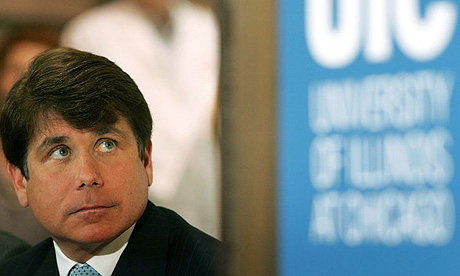 Students in my Introduction to American Law class know that the President of the United States may be removed from office if he is impeached by the House of Representatives and convicted by the Senate. In the House, impeachment requires a majority vote. In the Senate, conviction and removal must pass with 2/3 of the vote. Ever wonder how the chief executive officer of a state (a Governor) can be removed from office? Well, we may just be getting a lesson on this soon. Yesterday morning the Governor of Illinois (pictured) was arrested by the FBI on corruption charges; the main charge being that he was trying to fill President-elect Obama's Senate seat by choosing the person who gave him the most money. As an aside, the Illinois Constitution gives the Governor the power to fill a vacant U.S. Senate seat. In short, he was trying to sell the position formerly held by Obama. The Governor has not resigned, and from what I know of him, he probably will fight these charges to the bitter end. But the Illinois legislature does not have to wait to the end. They can remove him. According to the Illinois Constitution, the Governor can be removed via a process that is identical to the process used to remove the President. Just in case you were wondering.

The law that organized the Homeland Security office first lists Homeland Security's duty to recognize that government itself can't secure the state without God, even before mentioning other duties, which include distributing millions of dollars in federal grants and analyzing possible threats.This seems to raise the same question that I ask myself every time I see an athlete praise God after a sporting event. If both teams ask for God's help with winning, do members of the losing team blame God for the loss? In the instance above, if God gets credit for securing the State of Kentucky, might he be blamed should something terrible happen there? Probably not. Instead the blame will be placed at the feet of "abortionists" gays and the ACLU. (follow the link and see quote number one if you are unsure what this means).
 Is the United States a direct democracy? Surely not, at least at the federal level. The President is not elected by "the people" but by an Electoral College. There is no ability for citizen referendum or other direct citizen input at the federal level. And judges are appointed by politicians for life. These are just a few features of the federal government that make it anything but a version of direct democracy. But many states, especially California, do have governments that make them look closer to a direct democracy. In California, citizens can amend their constitution by referendum. Their judges can be voted out of office at the end of their term by the people, and politicians (including judges) can be removed in the middle of their term by recall.

1. President
2. Vice President
3. Speaker of the House
4. Senate President Pro Tem
5. Secretary of State
6. Secretary of the Treasury
7. Secretary of Defense
8. Attorney General
Of course, constitutional scholars believe this federal law is unconstitutional because the Constitution only talks about the Vice-President and then an officer (many believe this means member of the Cabinet) with regards to succession.
The members of the current Supreme Court, by age:
John Paul Stevens, 88
Ruth Bader Ginsburg, 75
Antonin Scalia, 72
Anthony Kennedy, 71
Stephen Breyer, 69
David Souter, 68
Clarence Thomas, 60
Samuel Alito, 58
John Roberts, 53
The last 10 justices to leave the Supreme Court, with their age and date of retirement:
Sandra Day O'Connor, 75, Jan. 31, 2006
William Rehnquist, 80, Sept. 3, 2005
Harry Blackmun, 85, Aug. 3, 1994
Byron White, 76, June 28, 1993
Thurgood Marshall, 83, Oct. 1, 1991
William Brennan, 84, July 20, 1990
Lewis Powell, 79, June 26, 1987
Warren Burger, 79, Sept. 26, 1986
Potter Stewart, 66, July 3, 1981
William Douglas, 77, Nov. 12, 1975

focused explicitly on the effect that the Act could have on constitutional rights of homosexuals, concluding that "if the Supreme Court should reverse its ruling in Bowers and hold that private consensual homosexual acts between adults may not be prosecuted in civilian society, this would not alter the committee's judgment as to the effect of homosexual conduct in the armed forces. . . . Congress ultimately concluded that the voluminous evidentiary record supported adopting a policy of separating certain homosexuals from military service to preserve the "high morale, good order and discipline, and unit cohesion" of the troops.In short, concerning matters of the military, courts should basically defer to Congress, which is really what Courts generally do when applying the rational basis test. Which begs the question. Did the First Circuit really use something other than the rational basis test in concluding that the policy did not violate the Constitution? It doesn't appear so.
 Students learning about common law sometimes question whether the jury system is an efficient and just way to run a legal system. News out of Sydney, Australia may support the proposition that in fact jury trials are a waste of time, not to mention a waste of money. At least this particular trial was. Yesterday a judge presiding over a three-month-long jury trial that cost the state over a $1 million dismissed the jury before they could reach a verdict because it was discovered that at least four members of the jury spent a good deal of time in the jury box playing Sudoku when they should have been paying attention to the trial. There is no law prohibiting jurors from being inattentive, even if the inattentiveness results in the judge ordering a retrial. Apparently, officials in the state of New South Wales are considering a rewrite of their jury rules that would, at the very least, prohibit jurors from playing games while sitting in the jury box. Probably not a bad idea.
 One of the more important recently decided Commerce Clause cases dealt with whether the federal government could enforce federal anti-drugs in California after voters there decided to legalize marijuana for medicinal purposes. (see Raich v. Gonzalez) The answer given by the U.S. Supreme Court was yes, the Feds can arrest people for using marijuana even if users are doing so pursuant to California state law. The question many students must have is: so is it still legal to purchase marijuana in California, under state law, for medicinal purposes? The quick answer is under state law YES, but people who use the drug still run the risk of being arrested by federal agents under federal law. But it gets even more confusing. The San Diego Union-Tribune newspaper recently reported that San Diego County is suing the State of California to repeal the medical marijuana laws. Lawyers for San Diego and San Bernardino counties will argue that the state cannot force counties to issue identification cards to qualified medical marijuana patients because the drug is illegal under federal law.
 By now students in my Constitutional Law class are quite familiar with the federal system of government in the United States. But I cannot emphasize enough the fact that the fundamental rights contained in the Constitution and its Amendments represent the bare minimum of rights enjoyed by residents of the United States.
 As we discussed last week, the Constitution sets up the potential for conflict between Congress and President when American troops are sent overseas and placed in harms way. Article I clearly gives Congress the power to declare war, but Article II makes the President Commander-in-Chief, which inherently gives him the power to defend the United States without obtaining approval from Congress. Presidents have defined "defend" rather broadly, dispatching troops to places like Panama and Beirut and putting them in war-like situations without getting approval from Congress. I just came across a piece on the English Deutsche Welle site about a case that many of you probably are already aware of. It seems that the German Constitutional Court has settled this question about who has the power in Germany to dispatch troops to foreign soil. Any deployment of German troops to foreign soil must be done with the approval of the Bundestag, so said the Court. There are a number of reasons why it was easier for the German Court to deal with this issue then it would be for the U.S. Supreme Court. For starters, there is much clearer division of power between branches in the United States. Second, as a rule the Supreme Court does not answer "political questions." More on that next week.
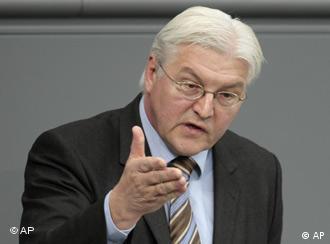 In case you missed it, German Foreign Minister Frank Walter Steinmeier has rejected an idea put forth by Chancellor Merkel for the creation of a U.S.-style National Security Council. As you will recall from our last Constitutional Law lecture, the NSC was set up to counsel the President concerning relations with foreign countries. It's no wonder why Herr Steinmeier would oppose such a move. American Secretaries of State (the equivalent of the German Foreign Minister) have generally had cool relations with the NSC. And why wouldn't they? The NSC is basically serving a similar role as the Secretary of State, meaning the Secretary has competition for the President's attention on matters of foreign relations.
 Last Monday, students of American Constitutional law were introduced (or possibly re-introduced) to the concept of a filibuster, which is unique to the U.S. Senate. By way of review, a filibuster is a tool that Senators can use to block debate of a bill they do not like. The filibuster itself is basically an endless debate that, because of it's duration (endless), prohibits the Senate from voting on a bill. The filibuster can only be stopped by way of a Cloture vote, which requires 60 Senators to vote in favor of ending the debate. Thus, a super-majority is needed to stop this delay action being taken by a minority of Senators. The mechanics of how this works are not really important for this class, especially considering that the Constitution itself does not grant this power to the Senate; so it's really outside the scope of this class. Nevertheless, there is an article in today's New York Times explaining how Republicans in the Senate are using the filibuster to block a vote on a bill that would make it easier to sue employers for wage discrimination. The article is worth a read if you are interested in how the filibuster can be used.

Consider the Constitution's commerce clause, which empowers the national legislature to regulate "commerce … among the several states." Since the New Deal the commerce clause has been construed very broadly, becoming the constitutional backbone of much important civil-rights legislation and of all the major environmental laws. Yet since 1995 the Court has issued a series of decisions that emphasize the limits of the commerce power, requiring that laws enacted under it deal in some sense with—well, interstate commerce. I have considerable sympathy for this line of argument, but its potential dangers to the environment are hard to overstate. For while the environment itself is intrinsically interstate, not all environmental-protection measures obviously constitute regulations of commerce "among the several states"—or even regulations of commerce at all. Can the government, under the Endangered Species Act, protect—as one conservative judge poetically put it—"a hapless toad that, for reasons of its own, lives its entire life in California"? Can it, under the Clean Water Act, protect isolated seasonal pools (which are not interstate) used by migratory birds (which are)?His point is, if enough judges on the Supreme Court believe that Congressional power under the Commerce Clause is not very broad, might the Court start striking down laws aimed at protecting endangered animals and wetlands? Good question and one that makes environmentalists in the United States lose sleep.
IN RECENT YEARS, a number of possibly deserving litigants have been denied their day in court after the Bush administration claimed that too many secrets would be spilled in an open trial. The cases of people who alleged they were subjected to illegal eavesdropping or were handed over to a foreign country in an "extraordinary rendition" have been fended off in this way.But now Congress is trying to change this by passing a law that would allow courts to look more closely at the state secrets defense that has been raised in these cases. This is a classic example of one branch (Legislative) trying to place limitations on another branch (Executive) by giving the third branch (Judiciary) more power to check government actions. Whether Congress has the power to do this will be a topic we will address next week.
 One of several important cases argued before the U.S. Supreme Court this week involves whether states can require people to show a picture ID (driver's license, passport, any other government-issued identification card with a picture on it) before being allowed to vote. The arguments for strict voter ID rules deal with stopping voter fraud. The arguments against such strict rules focus on access to voting as a large segment of lower income people in the U.S. may have difficulty meeting a strict ID test (put another way, they may not have a picture ID). For more on this issue, I suggest taking a listen to this piece on National Public Radio and reading this article in the New York Times. I've never asked anyone before what voters in Germany have to show before they can vote?