Matt LeMieux

03 March 2009

Parting Thought

Posting has been light because of the semester break. I will resume posting in early April. As a parting shot, I wanted to share a little something from the website of my local paper, which recently had an insert on Barack Obama. The following survey question was on the website for the newspaper:

Gibt Obama auch Ihnen Zuversicht?
Ja. Ich glaube, dass er überzeugende Antworten auf die globalen Probleme des 21. Jahrhunderts hat.
Nein. Er wird sich wie fast alle US-Präsidenten um amerikanische Interessen kümmern - um nichts weiter.

So let me get this straight, Obama and all past Presidents are judged by how well they have tackled global problems? If they have instead opted to tackle the problems facing the people who actually elected them, they are seen as merely protecting American interests and nothing more? Is this really a fair question? Not surprisingly, 85% of respondents opted for "Nein."

29 January 2009

When Congress Can Reverse the Supreme Court

When is the Supreme Court the law of the land and when is legislative overruling of the Supreme Court appropriate? Today President Obama signed his first bill into law as President. The bill dealt with equal pay for women. More specifically, it dealt with an instance where the Supreme Court interpreted a federal law one way, and Congress turned around and passed a new law which basically said that the Supreme Court's interpretation was wrong (by the way, this is what is meant by legislative overruling). Can Congress do that? Sure, but only when Congress is reversing the Court's interpretation of a FEDERAL LAW. It is different, however, if the Court says that a federal violated the U.S. Constitution. This is what is meant by the Supreme Court is the law of the land. The Court and only the Court has the last say on what is and what is not constitutional. But not every matter deals with the Constitution, and quite often the Court is merely asked to interpret a federal law that has nothing to do with the Constitution. The website Scotusblog has more.

28 January 2009

When Family Autonomy Goes Too Far

Students in my Introduction to American Law class recently learned that family law in the United States is primarily regulated by state law. I did, however, give some examples as to when federal law (or more specifically the federal constitution) comes into play in the area of family law. The primary example concerns a liberty interest that is sometimes referred to as familial relations. Put simply, there are some instances when the state, via family law, cannot interfere with the relationship between parents and children. But obviously this has its limits. A recent New York Times piece on parents who are being criminally charged after failing to provide their child with medical care led to her death illustrates the limits. The case concerns parents who believed that only God could heal their sick child. They are now claiming that using child neglect and endangerment laws against them violates their constitutional rights to freedom of religion. This sounds outlandish, but this area of the law is actually still somewhat unsettled in the United States, which is why this case is receiving a bit of attention. The Times piece is a must-read if you are interested in this topic.

27 January 2009

Debts and Marital Property

For those of you in my Introduction to US Law class, a recent story in the international press may have caught your eye and made you think. Former Lehman Brothers CEO Richard Fuld apparently "sold" his $13.3 million Florida home to his wife for $100 (or $10 depending on the news story you read). Why would he do that? Isn't it still a marital asset that can be claimed by a creditor? Based upon what we discussed in class, the answer is yes, but as a technical matter the answer is no for a variety of reasons. First, as a general matter, marital debt is shared just as marital assets are. But if shareholders of Lehman obtain a judgement for money against the former CEO, this debt could be considered personal to Fuld alone, not a marital debt. Thus, by transferring the home into his wife's name, it is possible that the home would be protected from creditors of Fuld. Second, Flordia has a law that protects the family home from creditors. Some have agrued that Fuld himself is not a Florida resident but his wife is. Thus, for her this is the family home and it could be protected from creditors under Florida law. You can find a bit more on this here (in German) and here (in English).

23 January 2009

The Treaty Power

Earlier this month two former members of the Bush Administration published on op-ed in the New York Times encouraging the Senate to use it's treaty power to keep President Obama check. The argument is simply breath-taking when you stop to consider that these two individuals played an important role in the Bush Administration's power grab after September 11. During their years in service, these two men were part of an effort to create an imperial presidency that had no use for the checks and balances built into the Constitution. They were part of an effort to keep secrets from Congress. They were part of a group that consistently told the Supreme Court it had no jurisdiction to review decisions made by the President.

So why do these two who once advocated for a supreme President now want Congress to keep the new President in check via the Treaty Clause of the Constitution? Simple really. Pursuant to the Treaty Clause, the President needs 66 votes in the Senate to ratify a treaty. These two former Bush aides are scared to death of the U.S. losing it's sovereignty by signing treaties dealing with global warming and international war crimes tribunals (read their op-ed and you will see what I mean). By claiming that the President should be forced to use the usual treaty route (the article explains, and student in my Constitutional Law class learn, how Presidents can get around the Treaty Clause), they are banking on the 41 Republican members of the U.S. Senate voting against such treaties, effectively defeating ratification.

A simply shameless argument, really, but not wholly unexpected. Look for more of this kind of back-tracking by people who supported the imperial presidency of George Bush. Now that they are out of power, an all powerful President doesn't seem like such a good idea. Go figure.

21 January 2009

Rendered to Guantanamo

Students in my Debating Controversial Supreme Court Case class recently learned about one of the cases dealing with the detainees being held at Guantanamo Bay, Rasul v. Bush. Part of our discussion focused on whether the men being held there are/were truly the "worst of the worst" who were "picked up on the battlefield" as the American public was repeatedly told by Bush Administration officials. The New York Times recently ran an article about a former detainee who was picked up in Indonesia and whisked off to Guantanamo as part of the extraordinary rendition program being run by the U.S. government. The other thing you should check out if you are remotely interested in this topic is a radio program put together by the public radio program This American Life. Acts One and Three by Jack Hitt chronicle the lives of a few of the detainees. If these two pieces don't make you question whether Guantanamo housed the "worst of the worst" than nothing will.

20 January 2009

It's All About "Hope" . . .

. . . sometimes "change" too. The Economist has a great graph charting the use of the words "hope" and "change" in past inauguration addresses. Interestingly, the Presidents who used the word "hope" in their address the most were mostly Republicans. And only Bill Clinton used the word "change" more than "hope". Check out the graph and then check back after the speech to see how Barack Obama fits into this Hope-o-meter.

UPDATE - the graph on The Economist blog has been updated to include Obama's speech.

19 January 2009

King's Vision Fulfilled

Today is Martin Luther King Day in the United States. It is somehow fitting that the inauguration of the nation's first African-American President takes place a day after. I cannot help but wonder whether a recent CNN poll showing that 2/3 of African-Americans feel that King's vision has been fulfilled and the Obama's rise to the presidency are not somehow related. According to CNN:

The poll found 69 percent of blacks said King's vision has been fulfilled in the more than 45 years since his 1963 "I have a dream" speech -- roughly double the 34 percent who agreed with that assessment in a similar poll taken last March. But whites remain less optimistic, the survey found.

Thus, in one year the number of African-Americans who feel King's dreams have been achieved has doubled! Can the election of one man really have changed so many minds? Or is this just a case of people being swept away by the symbolic significance of what we will see tomorrow?

18 January 2009

The Government's Lawyer in THE Court

While students in my Debating Controversial Supreme Court Cases course are tackling the social and cultural issues underpinning many of these controversial cases, I am afraid that I have been lax in explaining what happens when these cases actually reach the Supreme Court for argument. In this post I want to address the role of the federal government in cases that reach the Court, or more specifically the role of the Solicitor General.

The United States Solicitor General is the person chosen by the President to argue cases on behalf of the government in the Supreme Court. In addition to actually arguing cases, the Solicitor General may also file amicus briefs in support of a party whose position is favoured by the government.

So why write about this now? Simple. President-elect Barack Obama has appointed the Dean of Harvard Law School, Elena Kagan, to be the next U.S. Solicitor General. This is significant because she will be the first female to hold this post (it should be noted that a woman held this post for six months on a temporary basis during the transition between the Clinton and Bush administrations). The fact that the media has not highlighted this landmark achievement for women may say much about how the presence of women in high powered positions is changing in the United States.

More importantly, Kagan's selection and the people with whom she is surrounding herself illustrates the dramitic shift that is taking place in Washington. For instance, Kagan has chosen a lawyer who argued before the Court on behalf of the rights of detainees at Guantanamo as one of her deputies. Put another way, people who spent the last eight years arguing against positions taken by the Bush Administration will now be representing the government before the Court!

UPDATE - the New York Times has more on Ms. Kagan, including the fact that she will be the first woman to fill the post.

15 January 2009

The S Word

No, not that S word. I am talking about the one conservatives in the United States like throw around when talking about those on the left side of the political spectrum: Socialist. Students in my Law and Society class may be a bit surprised that some in America still believe there is a Red menace in America. Didn't that become passe with the end of the McCarthy era? Apparently not, at least not for those who get their news from Fox News. Under the headline: "Obama Climate Czarina Was Member of Socialist Group's Environmental Commission," Fox tells it's readers that:
Carol Browner, President-elect Barack Obama's choice to be his climate czarina, served until last summer as a member of a socialist organization whose mission is to enact progressive government policies, including toward environmental concerns like climate change.
Can you imagine? The person soon-to-be President Obama wants to deal with climate issues aims to enact progressive policies regarding climate change. The nerve!

05 January 2009

Limiting it's own Reach


Students of common law, and more specifically American law, know that the rulings of the U.S. Supreme Court form binding precedent on courts below it. But happens when the Supreme Court itself says that it's decision is only limited to the case before it, and thus not binding on future cases in lowers court? That is exactly what the Court did in the infamous case of Bush v. Gore. That is the case, you may remember, that gave George Bush the presidency after the hotly contested 2000 election. Using the now famous words: "Our consideration is limited to the present circumstances," the Court limited, or at least tried to limit, the reach of its importance in future cases. Mission accomplished? Until recently yes, but a spate of election-related lawsuits have called into question whether the Court has successfully limited the reach of it's ruling. The New Times has more.

19 December 2008

Be Back Next Year


Posting to the blog will stop for Christmas break. I will resume posting on or around January 5th.

17 December 2008

Amending the Constitution

The American constitution has been changed (amended) only 17 times in the last 221 years. Students in my Introduction to American Law class were told how difficult it is to amend the constitution, but some legal scholars beg to differ. According to a piece in the Wall Street Journal, some scholars think that the founding fathers wanted a constitution that could be amended with relative ease. The article is worth the read if you are at all interested in how the American constitution can be changed.

Gun Control

I just wanted to follow up on the very informative presentation that was given in our Debating Controversial Court Cases class last week concerning gun control. As our presenters noted, Washington D.C., the city whose law was struck down by the Supreme Court as violating the 2nd Amendment, is busy trying to pass new gun ownership restrictions. The Associated Press had a piece on the subject yesterday. It's worth a look if you are interested in the topic.

15 December 2008

Presidential Power and the War on Terrorism

What are the limits of Presidential power? The Bush Administration's "war on terrorism" has sought to push the limits of presidential power, and was doing so rather successfully until the Supreme Court started reviewing the question a few years ago. The Administration has now lost three of four cases before the Court concerning their anti-terrorism policies, all of which they say stem from the power of the President. Might the Administration be heading for it's fourth defeat? The Court has decided to grant review in a case dealing with a terrorist suspect who was seized in the United States and has been held in custody for six years without any hint of criminal charges being filed. In short, the question is whether the President can designate someone not picked up on the battlefield as an enemy combatant and detain that person indefinitely. McClathy news service has more on the case.

14 December 2008

Student Free Speech

A few weeks ago in my Debating Controversial Court Cases class, we had a lively discussion about the Tinker v. Des Moines case and whether students should have free speech rights in schools. As I mentioned in class, it seems like the Courts deal with this issue often as they struggle to balance the free speech rights of students with the interest of schools to keep order and educate students. A very interesting case was recently argued before the Third Circuit Court of Appeals. The Pittsburgh Post-Gazette reports:
What began as a lowbrow parody of a high school principal goes before a federal appeals court this week.

The case of Justin Layshock, who lanced his principal with an unflattering Internet "profile" created on a home computer, has become a battleground pitting Pennsylvania school administrators against groups that defend free-speech rights.

The 3rd U.S. Circuit Court of Appeals in Philadelphia will hear arguments from each side Wednesday.

Mr. Layshock used his grandmother's computer in December 2005 to create a fictitious profile of Hickory High School Principal Eric Trosch. Mr. Layshock, then a high school senior, made fun of the principal's bulk and implied that he smoked marijuana. Mr. Layshock posted the profile on the Internet social site Myspace.com.

Angered, Mr. Trosch and administrators of the Hermitage School District in Mercer County suspended Mr. Layshock from school for 10 days. After that, they placed him in an "alternative" education program that Mr. Layshock considered inferior.
Seems hard to believe that schools could possibly punish students for speech they engage in outside of school, but the Internet has truly changed the nature of speech. The Philadelphia Enquirer has more.

12 December 2008

Executions Hit 14-Year Low

At some point or another the topic of the death penalty has been mentioned in each of my classes this semester. Recently, I was asked about how many executions are carried out each year in the United States. I had to admit my ignorance, and state simply that I knew the number was lower than usual because of a recent Supreme Court case. Thanks to the fine folks at Reuters, who ran a story yesterday about how executions have reached a 14-year low, we now have some answers. Last there were 37 executions, and this new low was indeed partly caused by a moratorium on executions while the Supreme Court decided whether death by lethal injection violated the Constitution (they ultimately decided it does not). But another reason is the continuing decrease in the number of death sentences that are handed out. Some statistics on the death penalty, which states have it, how many executions per states, etc., can be found here.

11 December 2008

Police Chief Charged in Boy's Death at Gun Fair

Tragic news from Massachusetts illustrates how the crime of involuntary manslaughter works. A local police chief has been charged with involuntary manslaughter in the death of boy who attended a gun show put on by the police chief. The Boston Globe reports:
A small-town Massachusetts police chief who authorities say promoted, organized and profited from a firearms exposition where children were encouraged to shoot machine guns and where an 8-year-old killed himself with a Micro Uzi was charged Thursday with involuntary manslaughter.

Although the event was promoted as an opportunity for children to fire machine guns under the supervision of certified instructors, 8-year-old Christopher Bizilj had been supervised by a 15-year-old boy who was "knowledgeable about guns" but not certified as a firearms instructor, Hampden County District Attorney William M. Bennett said in outlining charges against Pelham Police Chief Edward B. Fleury and two others.

The elements of involuntary manslaughter under Massachusetts law are:

One can commit involuntary manslaughter through:
(1) an unintentional killing occasioned by an act which constitutes such a disregard of the probable harmful consequences to another as to be wanton or reckless; or
(2) an unintentional killing resulting from a battery.

10 December 2008

Impreachment

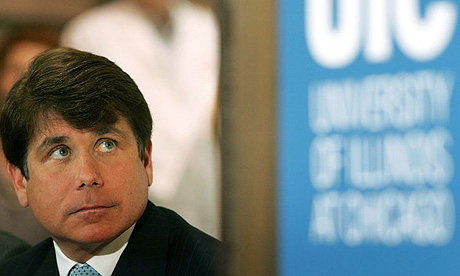
Students in my Introduction to American Law class know that the President of the United States may be removed from office if he is impeached by the House of Representatives and convicted by the Senate. In the House, impeachment requires a majority vote. In the Senate, conviction and removal must pass with 2/3 of the vote. Ever wonder how the chief executive officer of a state (a Governor) can be removed from office? Well, we may just be getting a lesson on this soon. Yesterday morning the Governor of Illinois (pictured) was arrested by the FBI on corruption charges; the main charge being that he was trying to fill President-elect Obama's Senate seat by choosing the person who gave him the most money. As an aside, the Illinois Constitution gives the Governor the power to fill a vacant U.S. Senate seat. In short, he was trying to sell the position formerly held by Obama. The Governor has not resigned, and from what I know of him, he probably will fight these charges to the bitter end. But the Illinois legislature does not have to wait to the end. They can remove him. According to the Illinois Constitution, the Governor can be removed via a process that is identical to the process used to remove the President. Just in case you were wondering.

09 December 2008

The Right to a Speedy Trial

Students in my Introduction to American Law class heard me say last week that the right to a speedy trial found in the U.S. Constitution is almost meaningless. I stand corrected, at least for the time being. Apparently, the Vermont Supreme Court recently ruled that a conviction had to be overturned and the defendant let free because he was not given a speedy trial. The case is currently pending before the U.S. Supreme Court, so my hunch is the right to a speedy trial will return to being meaningless once the Justices get through with this case.