Matt LeMieux

11 November 2009

Judges Reject Rendition Suit

Extraordinary rendition. This is the program used by the U.S. government shortly after September 11, 2001, whereby terrorist suspects were kidnapped and sent to third countries where they could be interrogated using torture. One such victim, a Canadian who was picked up in Kennedy International Airport in New York and whisked off to Syria where he was detained and tortured for a year, was told by the United States Second Circuit Court of Appeals that he cannot sue the U.S. government because Congress did not authorized such a suit. Ben Weiser, of the New York Times writes:
In saying that he could not sue officials involved in his rendition, the United States Court of Appeals for the Second Circuit ruled by a vote of 7 to 4 that Congress could always create a civil damages remedy for harms suffered through rendition, but it had not done so.

“We decline to create, on our own, a new cause of action against officers and employees of the federal government,” Chief Judge Dennis G. Jacobs wrote in a 59-page majority opinion joined by six other judges.

Judge Jacobs said that it was for the executive branch to “decide how to implement extraordinary rendition, and for the elected members of Congress — and not for us as judges — to decide whether an individual may seek compensation” from government officials for a constitutional violation.
Setting aside the question of how Congress could have created a remedy for violations arising from a program about which it was not informed by the Bush Administration, there are some very interesting points to take away from this article.

First, in class students are told that hearings in the Court of Appeals are presided over by a three judge panel. So how do we get a 7 to 4 vote here? The decision was actually one made by an "en banc" panel. See here for a full discussion of this.

Second, boiled down to its simplest form, the argument being made by the majority here is they do not have jurisdiction to hear this case. Remember, Article I of the U.S. Constitution gives Congress the power to create lower federal courts and determine the courts' jurisdiction.

Finally, one could argue that this is an example of there being no common law in American federal courts. Many scholars argue that the only sources of law in the federal courts are statutes and the Constitution, not common law. When the judges say "we will not create a remedy," what they are really saying is we will not create a common law (judge-made) remedy.

08 November 2009

Is A Lawn Mower a Motor Vehicle?

This question, as hard as it may be to believe, is currently before the Georgia Supreme Court. Why? Because people who steal "motor vehicles" in Georgia can be sentenced to long prison terms. So can someone who steals a riding lawn mower be eligible for one of these long prison sentences? The answer to this question hinges on whether a lawn mower is a motor vehicle. If so, then the defendant in this case can be sentenced just like he would have had he stolen an automobile. In the end, this is a classic case of statutory interpretation where the court's primary objective is to determine the intent of the legislature when it enacted the law. Law.com has more on this particular case. Once the Georgia court rules, I too will have more.

06 November 2009

Case Before the Court

We are now a full month removed from the First Monday in October, which, as many American know, is the first day of new U.S. Supreme Court term. There are several very interesting cases on the Court's docket this session, ranging from whether films depicting the brutal death of animals are protected by freedom of speech to whether juveniles can be sentenced to life in prison without violating the 8th Amendment's prohibition on cruel and unusual punishment. The Wall Street Journal had an excellent piece on the new term last month. It can be found here.

04 November 2009

Vote or Appoint?

Judges in the United States come in all forms. Some are appointed for life (all federal judges and some state judges), some are appointed and then face the electorate for a retention vote. Put another way, if the public doesn't like the judge, they can vote him or her out of the judiciary. And some become judges through open, partisan elections. Supporters of the later form of selecting judges claim that allowing the citizens to chose the judges makes the courts more accountable. But critics say that making judges run for election requires them to raise campaign funds, making them beholden to special interest groups who gave them money. The critics may have one more example to justify their opposition to judicial elections: the race for an open seat on the Pennsylvania Supreme Court. The Associated Press has more on this ugly race for the high court and how many in the Keystone State are now questioning whether this is the best way to select a judge.

03 November 2009

Time to Retire

Answering the question of how long one can serve as a judge in the United States is not easy. First, one must distinguish between the federal and state systems. In the federal system, the answer is as long as the judge wants. Federal judges are appointed for life and many serve until they die. In the states, the question is somewhat more complicated. Only a handful of states appoint their judges for life. A majority of states elect their judges by popular vote. Thus, one sits as a judge as long as one can continue to get elected. But a recent Associated Press piece sheds some light on the question of whether states who do not appoint their judges for life force their judges to retire at a certain age. To be honest, I had never given this question much thought. Turns out that over half of the states have laws or constitutional amendments that require their judges to retire at a certain age. In most of these states, 70 is the age of retirement. In Vermont it is 90!

30 October 2009

Get a License or Else!

The lawyer plays a central role in many of my classes. In my Introduction to American Law class, we learn what it takes to become a lawyer. What I generally do not cover is this questions: What happens to people who practice law without a law license? Usually cases dealing with this question involve instances where one is actually engaged in the practice of law is questionable. Put another way, we are usually not talking about someone who shows up in court pretending to be a lawyer. Normally, we are talking about non-lawyers offering services, such as drafting wills or trusts, that are legal in nature. One company in Ohio recently found out what happens when one crosses the line between simple consulting and the practice of law. The Columbus Dispatch has more.

29 October 2009

A Peek Inside the Court

During a recent visit to the University of Alabama, U.S. Supreme Court Justice Clearance Thomas gave UA law students and audience members a glimpse inside the otherwise secretive decision making process of the Court. As students in most of my courses learn, appellate arguments in the United States usually involve judges asking the lawyers of both parties numerous questions. A typical hearing before the U.S. Supreme Court looks more like an question and answer session than an argument being presented by lawyers. But according to Justice Thomas, this Q&A is at best unnecessary and at worst downright bothersome. The Associate Press reports:
Thomas - who hasn't asked a lawyer a question during arguments in nearly four years - said he and the other eight justices virtually always know where they stand on a case by reading legal briefs before oral arguments.

"So why do you beat up on people if you already know? I don't know, because I don't beat up on 'em. I refuse to participate. I don't like it, so I don't do it," Thomas said during an appearance before law students at the University of Alabama. . . .

Thomas scoffed at the idea that the justices try to use questions to influence the opinions of fellow members of the court. "All nine of us are in the same building," he said. "If we want to sway each other we know where we are. We don't need oral arguments to do that. It doesn't make any sense to me.

The Tuscaloosa News has more on Justice Thomas' visit.

27 October 2009

Still On The Books

Fresh on the heels of our discussion in my course "The Law and Social Change" comes this piece from the First Amendment Center in the United States:

Watch your language out there, because profanity and blasphemy could lead to criminal charges. We might hope that First Amendment-protected free speech lets us utter profanities, blasphemies and other choice phrases that occasionally slip from our intemperate tongues. After all, the U.S. Supreme Court protected a man who wore a jacket into a Los Angeles County Courthouse bearing the words "Fuck the Draft." That led to the famous Cohen v. California (1971) ruling in which Justice John Marshall Harlan — a conservative during the Warren Court years — uttered a phrase that has become First Amendment lore: "One man's vulgarity is another's lyric." But hold on. Yes, in a free society adult citizens outside of special contexts (jobs, military, school) can speak their minds in the open air. But if you think old laws punishing profanity and blasphemy no longer exist, you're wrong — a surprising number of state laws still prohibit such speech. Even though the laws are rarely enforced, they are still on the books.
You can read more here.

20 October 2009

Welcome Back and Congrats to Medical Marijuana Users

After a long break, I will resume posting topics of interest to students in all of my classes on this blog. I'd like to start by revisiting a topic familiar to former students, and one that should be of interest to students in any of my classes where we discuss some aspect of the United States Government. As I wrote back in summer of 2008, medical marijuana users in states like California, where the use of pot for medical reasons was made legal under state law, were put in a bind several years back when the U.S. Supreme Court said that the federal government could arrest and prosecute people for using marijuana, a practice the Bush Administration was in favor of, because it violated federal law. Put another way, the use of medical marijuana was legal under state law but illegal under federal law. What was a medical pot user to do?

Unless you have been in a cave for the past year, you know that there has been a sea change in Washington D.C. with the election of President Obama, and it appears that this change is even reaching the medicinal pot users. How so? Well, the Department of Justice (the federal office responsible for enforcing the federal anti-pot laws) recently decided that the limited federal law enforcement resources may be better spent going after real criminals instead of people who are doing something perfectly legal under their state's law. They will no longer enforce federal law against medicinal pot users in states where the use of medical marijuana is legal.

For those new to this blog and/or this topic, this issue really illustrates: 1) how state and federal governments can have different laws, 2) how the laws can sometimes conflict, and 3) how a change in government can make a huge difference, among other things.

23 July 2009

Back in October

I will resume posting after the semester break. Until then.

22 July 2009

Can Non-Lawyers Judge a Judge?

Students in most of my classes have at some time or another become familiar with how the United States chooses its federal court judges. The short story: the President appoints and the Senate confirms. Students also know that there are no formal requirements needed to become a federal judge, other than being nominated by the President and confirmed by the Senate. In theory, the qualifications of the judicial nominee are to be tested via the Senate confirmation process. However, many of the members of the committee who question the nominee are not trained lawyers. This begs the question: How can non-lawyers judge whether a nominee is qualified to be a federal judge? David Ingram at Law.com has more on this.

10 July 2009

Sex Offender Registration Laws

Students in my debate and discussion class are familiar with laws in the United States that force convicted sex offenders to register with the county in which they live. Normally, the county publishes a list of convicted sex offenders living in the county. But some states have been taking this even further recently. Case in point: Florida, where state law says that a convicted sex offender cannot live within 2500 feet of a place where children might congregate. The impact of this law has created a real problem in larger cities like Miami. The Miami Herald has more (including a very fascinating video).

09 July 2009

A Ritual Worth Watching

Tony Mauro of the National Law Journal has a short, interesting piece explaining why next week's Supreme Court nominee confirmation hearings will be something to watch, or at least pay attention. Mauro's take can be found here.

24 June 2009

A Remedy for Torture

There is a very interesting case working its way through the American court system concerning torture. An American citizen, who was recently convicted of planning a terrorist attacks, claimed that he was tortured during his pre-trial detainment. The torture, he claims, was a direct result of legal memos drafted by one of President Bush's legal advisors. And now the tortured wants to hold the person who instigated the torture process accountable. The question for the court: can a detainee who was tortured sue the person responsible for providing the opinion that torture is legal. The answer, at least so far, appears to be yes. More on the very interesting Padilla v. Yoo case can be found at the online magazine Slate.

22 June 2009

The Rare Impeachment

Students in many of my classes have discussed at one point or another the process for removing the President, high executive officers and federal judges: impeachment. Between 1797 and 2008, only 17 individuals have been impeached, and of those only seven were removed. In short, this is a rare event in American history. Which is what makes last week's impeachment of U.S. Federal Court Judge Samuel Kent extraordinary. Judge Kent was recently convicted of obstruction of justice related to charges of sexual assault that were brought against him. Now in prison, Judge Kent remains a federal judge until he resigns or is removed. After last week's action in the House of Representatives, removal is looking increasingly likely. The Houston Chronicle has more.

UPDATE - According to the Associated Press, the process is now moving to the U.S. Senate.

19 June 2009

Commercial Speech

Just how much protection does commercial speech have under the First Amendment? That is the question that is being raised after Congress recently passed a law prohibiting tobacco advertising within 1000 feet (304 meters) of schools. The law contains other speech restrictions as well. Wednesday's New York Times has an interesting piece on the legislation, which President Obama says he will sign, and the constitutional issues. As the Times points out:
Commercial free speech is not an absolute right, legal experts say. There are clear limits, for instance, on false advertising and on promotion of illegal activity. The issue grows more complicated if the advertising is both truthful and concerns a legal activity, like smoking by adults.

The Supreme Court in 1980 said such speech can be restricted only if it would directly advance a “substantial government interest” and the regulation was “narrowly tailored” to fit the interest. In the case of the new tobacco law, Congress specifically defined the government interest as a reduction in youth smoking.

But the tobacco industry denies that any of its advertising is aimed at young people.
The American Civil Liberties Union (ACLU) has also taken issue with the law saying that the legislation’s limits on commercial speech are broader than needed to accomplish the goal of reducing under-age smoking, i.e. the law is not narrowly tailored.

18 June 2009

State Sovereignty

By now students in my constitutional law courses are likely sick of hearing me talk about the historical and on-going dispute concerning state sovereignty. As students will surely recall, this topic is the focus of our discussions concerning the Commerce Clause, Necessary and Proper Clause and the 10th Amendment. But rest assured that I do not drone on about this for nothing. This is a real and current debate, ever more so as this article in yesterday's Los Angeles Times points out.

It appears that some legislators in western states are not all that happy with President Obama and have decided that now is the time to challenge the power of the federal government. How do they intend to do this? Pass laws, especially dealing with gun control, that are in direct conflict to federal law with the hope that the courts will get involved in the dispute and overturn prior rulings that have given the federal government broad power. As the Times piece points out:
Supporters of the bill want the Supreme Court to eliminate gun controls and, eventually, curtail Washington's ability to set policy on a wide range of issues, including education, civil rights, law enforcement and land use.
As an aside, don't you find it somewhat disturbing that the modern cases challenging federal power seem to only involve sex (U.S. v. Morrison), drugs (Gonzales v. Raich) and guns (U.S. v. Lopez)?

16 June 2009

The Role of Bias in Jury Selection

The Baltimore Sun had a very interesting piece in yesterday's paper about the role that stereotypes play in jury selection:
Before a high-profile federal trial began in Baltimore last month, lawyers for the three black defendants filed a motion claiming that the prosecution deliberately - and illegally - dismissed black jury candidates to pack the panel with whites.

"They want a jury that may be sympathetic to the death sentence," defense attorney Archangelo Tuminelli said.

But the judge ultimately ruled that the allegation was wrong. And, it turns out, the stereotype might be, too.
I highly recommend reading the rest of the article here.

15 June 2009

Same Sex Marriage

What is the future of same-sex marriage in America? Students in my American Constitutional Law courses learned that the federal courts have not been a very friendly place for gay rights advocates primarily because they have not been open to treating gay and lesbians as a "suspect class." Thus, federal courts have had no problem finding laws such as the military's Don't Ask Don't Tell policy or the Defense of Marriage Act to be perfectly constitutional. But lawsuits in state courts have recently been far more successful. Georgetown law professor David Cole has a wonderful piece in next month's New York Review of Books about the history and future of same-sex marriage in the United States. It is worth a quick glance. At the very least, students should consider the three reasons Cole says are put forth by the government as why laws banning same-sex marriage are rationally related to a legitimate government interest:
(1) the state is responsible for preserving the traditional conception of marriage; (2) limiting marriage to heterosexual couples furthers the state's interests in promoting procreation and/or healthy childrearing; and (3) the state has a legitimate interest in refusing to condone homosexual behavior that it deems immoral.
Should any of these reasons be enough for the state to pass the rational basis test under the Equal Protection Clause?

10 June 2009

More in case you were wondering

A few days ago I posted a link to a Miami Herald story explaining why politicians do not want Guantanamo Bay closed. In short, no politician wants to be responsible for having these detainees moved onto American soil. Put another way, no one wants the detainees in their state or city. No one except a small town in Montana that is actually lobbying FOR the chance to house the detainees from Guantanamo Bay. CNN has more.

07 June 2009

Pot Revisted

Last year around this time I posted a piece about the medical marijuana law in California. My constitutional law students should be familiar with the case the concepts discussed as we covered both in class:
One of the more important recently decided Commerce Clause cases dealt with whether the federal government could enforce federal anti-drugs in California after voters there decided to legalize marijuana for medicinal purposes. (see Raich v. Gonzalez) The answer given by the U.S. Supreme Court was yes, the Feds can arrest people for using marijuana even if users are doing so pursuant to California state law. The question many students must have is: so is it still legal to purchase marijuana in California, under state law, for medicinal purposes? The quick answer is under state law YES, but people who use the drug still run the risk of being arrested by federal agents under federal law. But it gets even more confusing. The San Diego Union-Tribune newspaper recently reported that San Diego County is suing the State of California to repeal the medical marijuana laws. Lawyers for San Diego and San Bernardino counties will argue that the state cannot force counties to issue identification cards to qualified medical marijuana patients because the drug is illegal under federal law.
A few months later a California appeals court ruled that the federal law did not preempt the state law and ordered the two counties to issue medical marijuana licenses under the state law. The counties, of course, appealed their case to the U.S. Supreme Court (remember, because the federal law is at issue, the U.S. Supreme Court can have the final say). The Court declined to hear the case, letting the lower court ruling stand. As the L.A. Times reminds us:
Four years ago, the Supreme Court ruled that Congress and the federal government had the constitutional authority to regulate the sale and use of marijuana under its power over interstate commerce. The 6-3 decision, in the case of Gonzales vs. Raich, rejected the claim that personal use of homegrown marijuana was off-limits to federal authority. But the court did not rule on whether a state's law allowing medical use of marijuana was void because it conflicted with the federal law.
By rejecting the case, the Supreme Court is not saying that no conflict exists. It is simply saying that it does not want to review the California appeals court case. Thus, the issue is "settled" until the U.S. Supreme decides to revisit the issue via another case, if it ever does decide to do this.

05 June 2009

In Case You Were Wondering . . .

. . . why the U.S. Senate recently voted to withhold money from the President that could be used to close the detention center at Guantanamo Bay, this story from the Miami Herald does a nice job explaining why politicians are having cold feet over this issue.

29 May 2009

Are Justices Too Powerful?

Back in February the Washington Post printed a provocative article, which began:
If we had it to do all over again, would we appoint Supreme Court justices for life? Allow the chief justice to keep the job forever? Let the court have the final word on which cases it hears and those it declines?
If you are interested in the answers that more than a few law professors in the United States give to these question, I encourage you to read the rest of the article.

26 May 2009

Immunity from Criminal Prosecution

Students in my constitutional law courses know (or will know) that the President probably enjoys absolute immunity from criminal prosecution while he is in office. Most legal scholars maintain that the President must first be impeached before he can face criminal charges. But as this post over at the always informative Jurist website notes, judges do not enjoy the same kind of immunity from prosecution. U.S. Federal District Court Judge Samuel Kent recently was convicted of obstruction of justice related to a sexual harassment complaint filed against him. He is now serving 33 months in prison. However, Kent is still a federal court judge. Remember, the only means for removing judges in the federal system is via the impeachment process. This process, as one would expect, has already been started for his removal.

24 May 2009

Why Marbury Still Matters

Students of American Constitutional Law learn that Article III, the part of the Constitution that created the Supreme Court, did not actually give the Court the power to review the constitutionality of actions taken by the other two branches of government. This power was derived from the court decision, arguably the most important decision in American history, Marbury v. Madison. Newsweek recently had an interesting story explaining why Marbury is still relevant some 200 years later.

21 May 2009

More of the Same, Part 2

A few days ago I wrote about how the Obama Administration is defending of surveillance practices it inherited from the Bush Administration. But it's not just spying that apparently will remain the same. The much maligned practice of extra-ordinary rendition (the prisoner transfer program the involves kidnapping suspect terrorists and moving them to countries that have a . . . well . . . different view of torture than most western countries) apparently will also remain the government's anti-terrorism arsenal. The Los Angeles Times has more.

1 in 7 return to "terrorism"

The New York Times had a fascinating article in yesterday's paper about an internal U.S. Department of Defense report that claims 1 in 7 of the former Guantanamo detainees returns to "battlefield" against the United States. The article also talks about the dilemma facing the Obama Administration over what to do with the rest of the detainees still at Guantanamo. Some, according to experts, cannot be released and will have to face trial. But now members of Congress are balking at the idea of bringing some detainees back to the U.S. mainland for trial. In the article, F.B.I. director, Robert S. Mueller III, said that moving detainees to American prisons would bring with it risks including “the potential for individuals undertaking attacks in the United States.”

This quote left me wondering. How can moving people into American prisons increase the potential for individuals to undertake attacks in the U.S.? Does he mean the individuals who would be put in prison might engage in attacks? Or does he mean that now terrorists will have even more incentive (hard believe that is possible unless one thinks that people like Bin Laden have gone soft on the U.S.) to attack the U.S.?

17 May 2009

Apportionment

During a recent Constitutional Law lecture in Münster, a student asked who was counted for purposes of determining a state's population with regards to apportionment of the House of Representatives. As students in most of my classes have learned (or been reminded of) at some point or another, the number of representatives each state has in the House of Representatives is determined by the population of a given state. Most students are surprised to learn that every ten years a recount of the entire U.S. population is conducted via something called a census (this recount, incidentally is required by the Constitution). But I digress.

So who counts when determining a state's population? Everyone. That's right, citizens and non-citizens, legal residents and illegal residents, registered voters and non-registered voters, adults and children. Everyone. More information is provided here by our friendly Census Bureau (the fine folks who conduct this decennial recount).

As an aside, as part of my search for this answer, I came across information concerning a movement here in Germany back in the late 1970s to introduce a census. Apparently a planned census in 1983 was halted by the Bundesverfassungsgericht. More can be found here.

16 May 2009

The End of Affirmative Action?

The election of Barack Obama as President has some people wondering the whether programs that give preferences to racial minorities to correct for past discrimination are still necessary. National Public Radio recently hosted a half-hour discussion on the topic of Affirmative Action in the aftermath of the historic 2008 Presidential Election.

14 May 2009

How Big Must A Jury Be?

Popular culture has ingrained the belief in us that all juries have 12 people serving on it (the classic film "Twelve Angry Men" being the prime example of this). But the United States Supreme Court has repeatedly made it clear that having 12 people on a jury is not required by the U.S. Constitution. Two American law professors explain why it should be required.

Obama Nominee Blocked by Senate Republicans

Today's Washington Post contains an article about how members of the Republican Party in the U.S. Senate were able to block President Obama's nominee for Deputy Secretary of the Interior. The article provides a nice illustration of a few things that I have already addressed in many of my courses. First, that the President has the power to appoint officers of the Executive Branch. Second, that this power is not absolute because the U.S. Senate must confirm the President's choice. Third, that because of special rules that exist in the U.S. Senate, rules that are not found in the Constitution itself, a minority of Senators can block action in the Senate using something called a filibuster. As students may recall, the filibuster is basically non-stop debate. The Senate cannot vote on the matter at hand until the debate is finished, and under the rules of the Senate a filibuster can only be stopped if at least 60 Senators vote to stop it. The Democrats in the Senate were only able to muster 57 votes in favor of ending debate and thus the fillibuster worked in stopping the full Senate from voting on the confirmation. Take a look at the Post article for more.

12 May 2009

The More Things Change . . .

the more they stay the same, so the old saying goes. But is that true when it comes to spying on Americans? Put another way, did the election of Barack Obama as President change the surveillance tactics of the U.S. government? Not really, according to Wired's David Kravets.

11 May 2009

Banning the Flag


Can a public high school prohibit students from wearing T-shirts bearing the Confederate Flag? According to the Sixth Circuit Court of Appeals, the answer is yes. The court's decision, which is relatively easy reading, can be found here.

Court Says Florida Cannot Make Foreign Policy

Understanding who has what power in the United States can sometimes be confusing. Determining which branch of the federal government has what power is the easy part (O.K., not really). But more complicated are questions like: When does Congress have the power to regulate activity and when does that power belong to the states? But there is one area that the courts have been pretty consistent on when it comes to the question of who has the power: foreign policy. A recent case out of Florida provides a very nice example.

28 April 2009

Local Currency


Article I of the U.S. Constitution gives the federal government sole authority to print money. But that isn't stopping local businesses in cities like my hometown of Detroit from printing their own (il)legal tender. USA Today has more.

23 April 2009

Trying To Keep Up

It has been a busy few weeks for critics and defenders of the Bush Administration as numerous memos and reports related to the use of torture by U.S. officials have been released to the public. Trying to keep up with this flurry of information is daunting . . . but not impossible. Thanks to Foreign Policy Magazine's Passport Blog, you too can try to keep up with the latest news on the "war on terror" and torture. Take a look and remember, this is just the tip of the iceberg.

UPDATE - the Economist's Democracy in America Blog also has a torture news round-up. It seems as though torture is all anyone can talk about these days.

17 April 2009

Torture Docs Released

The Central Intelligence Agency (CIA) released documents yesterday related to torture techniques used by the prior Administration. The follows on the heals of the release of several legal memos by Attorney General Eric Holder that served as the legal basis in justifying the use of torture. ABC News has more.

15 April 2009

After the Fall


A while back I wrote about the impeachment of Illinois Governor Rod Blagojevich. In the last week the former Governor has been indicted AND signed on to star in an American reality show. I guess that answers the question of what happens to a person once they have been impeached.

03 March 2009

Parting Thought

Posting has been light because of the semester break. I will resume posting in early April. As a parting shot, I wanted to share a little something from the website of my local paper, which recently had an insert on Barack Obama. The following survey question was on the website for the newspaper:

Gibt Obama auch Ihnen Zuversicht?
Ja. Ich glaube, dass er überzeugende Antworten auf die globalen Probleme des 21. Jahrhunderts hat.
Nein. Er wird sich wie fast alle US-Präsidenten um amerikanische Interessen kümmern - um nichts weiter.

So let me get this straight, Obama and all past Presidents are judged by how well they have tackled global problems? If they have instead opted to tackle the problems facing the people who actually elected them, they are seen as merely protecting American interests and nothing more? Is this really a fair question? Not surprisingly, 85% of respondents opted for "Nein."

29 January 2009

When Congress Can Reverse the Supreme Court

When is the Supreme Court the law of the land and when is legislative overruling of the Supreme Court appropriate? Today President Obama signed his first bill into law as President. The bill dealt with equal pay for women. More specifically, it dealt with an instance where the Supreme Court interpreted a federal law one way, and Congress turned around and passed a new law which basically said that the Supreme Court's interpretation was wrong (by the way, this is what is meant by legislative overruling). Can Congress do that? Sure, but only when Congress is reversing the Court's interpretation of a FEDERAL LAW. It is different, however, if the Court says that a federal violated the U.S. Constitution. This is what is meant by the Supreme Court is the law of the land. The Court and only the Court has the last say on what is and what is not constitutional. But not every matter deals with the Constitution, and quite often the Court is merely asked to interpret a federal law that has nothing to do with the Constitution. The website Scotusblog has more.

28 January 2009

When Family Autonomy Goes Too Far

Students in my Introduction to American Law class recently learned that family law in the United States is primarily regulated by state law. I did, however, give some examples as to when federal law (or more specifically the federal constitution) comes into play in the area of family law. The primary example concerns a liberty interest that is sometimes referred to as familial relations. Put simply, there are some instances when the state, via family law, cannot interfere with the relationship between parents and children. But obviously this has its limits. A recent New York Times piece on parents who are being criminally charged after failing to provide their child with medical care led to her death illustrates the limits. The case concerns parents who believed that only God could heal their sick child. They are now claiming that using child neglect and endangerment laws against them violates their constitutional rights to freedom of religion. This sounds outlandish, but this area of the law is actually still somewhat unsettled in the United States, which is why this case is receiving a bit of attention. The Times piece is a must-read if you are interested in this topic.

27 January 2009

Debts and Marital Property

For those of you in my Introduction to US Law class, a recent story in the international press may have caught your eye and made you think. Former Lehman Brothers CEO Richard Fuld apparently "sold" his $13.3 million Florida home to his wife for $100 (or $10 depending on the news story you read). Why would he do that? Isn't it still a marital asset that can be claimed by a creditor? Based upon what we discussed in class, the answer is yes, but as a technical matter the answer is no for a variety of reasons. First, as a general matter, marital debt is shared just as marital assets are. But if shareholders of Lehman obtain a judgement for money against the former CEO, this debt could be considered personal to Fuld alone, not a marital debt. Thus, by transferring the home into his wife's name, it is possible that the home would be protected from creditors of Fuld. Second, Flordia has a law that protects the family home from creditors. Some have agrued that Fuld himself is not a Florida resident but his wife is. Thus, for her this is the family home and it could be protected from creditors under Florida law. You can find a bit more on this here (in German) and here (in English).

23 January 2009

The Treaty Power

Earlier this month two former members of the Bush Administration published on op-ed in the New York Times encouraging the Senate to use it's treaty power to keep President Obama check. The argument is simply breath-taking when you stop to consider that these two individuals played an important role in the Bush Administration's power grab after September 11. During their years in service, these two men were part of an effort to create an imperial presidency that had no use for the checks and balances built into the Constitution. They were part of an effort to keep secrets from Congress. They were part of a group that consistently told the Supreme Court it had no jurisdiction to review decisions made by the President.

So why do these two who once advocated for a supreme President now want Congress to keep the new President in check via the Treaty Clause of the Constitution? Simple really. Pursuant to the Treaty Clause, the President needs 66 votes in the Senate to ratify a treaty. These two former Bush aides are scared to death of the U.S. losing it's sovereignty by signing treaties dealing with global warming and international war crimes tribunals (read their op-ed and you will see what I mean). By claiming that the President should be forced to use the usual treaty route (the article explains, and student in my Constitutional Law class learn, how Presidents can get around the Treaty Clause), they are banking on the 41 Republican members of the U.S. Senate voting against such treaties, effectively defeating ratification.

A simply shameless argument, really, but not wholly unexpected. Look for more of this kind of back-tracking by people who supported the imperial presidency of George Bush. Now that they are out of power, an all powerful President doesn't seem like such a good idea. Go figure.

21 January 2009

Rendered to Guantanamo

Students in my Debating Controversial Supreme Court Case class recently learned about one of the cases dealing with the detainees being held at Guantanamo Bay, Rasul v. Bush. Part of our discussion focused on whether the men being held there are/were truly the "worst of the worst" who were "picked up on the battlefield" as the American public was repeatedly told by Bush Administration officials. The New York Times recently ran an article about a former detainee who was picked up in Indonesia and whisked off to Guantanamo as part of the extraordinary rendition program being run by the U.S. government. The other thing you should check out if you are remotely interested in this topic is a radio program put together by the public radio program This American Life. Acts One and Three by Jack Hitt chronicle the lives of a few of the detainees. If these two pieces don't make you question whether Guantanamo housed the "worst of the worst" than nothing will.

20 January 2009

It's All About "Hope" . . .

. . . sometimes "change" too. The Economist has a great graph charting the use of the words "hope" and "change" in past inauguration addresses. Interestingly, the Presidents who used the word "hope" in their address the most were mostly Republicans. And only Bill Clinton used the word "change" more than "hope". Check out the graph and then check back after the speech to see how Barack Obama fits into this Hope-o-meter.

UPDATE - the graph on The Economist blog has been updated to include Obama's speech.

19 January 2009

King's Vision Fulfilled

Today is Martin Luther King Day in the United States. It is somehow fitting that the inauguration of the nation's first African-American President takes place a day after. I cannot help but wonder whether a recent CNN poll showing that 2/3 of African-Americans feel that King's vision has been fulfilled and the Obama's rise to the presidency are not somehow related. According to CNN:

The poll found 69 percent of blacks said King's vision has been fulfilled in the more than 45 years since his 1963 "I have a dream" speech -- roughly double the 34 percent who agreed with that assessment in a similar poll taken last March. But whites remain less optimistic, the survey found.

Thus, in one year the number of African-Americans who feel King's dreams have been achieved has doubled! Can the election of one man really have changed so many minds? Or is this just a case of people being swept away by the symbolic significance of what we will see tomorrow?

18 January 2009

The Government's Lawyer in THE Court

While students in my Debating Controversial Supreme Court Cases course are tackling the social and cultural issues underpinning many of these controversial cases, I am afraid that I have been lax in explaining what happens when these cases actually reach the Supreme Court for argument. In this post I want to address the role of the federal government in cases that reach the Court, or more specifically the role of the Solicitor General.

The United States Solicitor General is the person chosen by the President to argue cases on behalf of the government in the Supreme Court. In addition to actually arguing cases, the Solicitor General may also file amicus briefs in support of a party whose position is favoured by the government.

So why write about this now? Simple. President-elect Barack Obama has appointed the Dean of Harvard Law School, Elena Kagan, to be the next U.S. Solicitor General. This is significant because she will be the first female to hold this post (it should be noted that a woman held this post for six months on a temporary basis during the transition between the Clinton and Bush administrations). The fact that the media has not highlighted this landmark achievement for women may say much about how the presence of women in high powered positions is changing in the United States.

More importantly, Kagan's selection and the people with whom she is surrounding herself illustrates the dramitic shift that is taking place in Washington. For instance, Kagan has chosen a lawyer who argued before the Court on behalf of the rights of detainees at Guantanamo as one of her deputies. Put another way, people who spent the last eight years arguing against positions taken by the Bush Administration will now be representing the government before the Court!

UPDATE - the New York Times has more on Ms. Kagan, including the fact that she will be the first woman to fill the post.

15 January 2009

The S Word

No, not that S word. I am talking about the one conservatives in the United States like throw around when talking about those on the left side of the political spectrum: Socialist. Students in my Law and Society class may be a bit surprised that some in America still believe there is a Red menace in America. Didn't that become passe with the end of the McCarthy era? Apparently not, at least not for those who get their news from Fox News. Under the headline: "Obama Climate Czarina Was Member of Socialist Group's Environmental Commission," Fox tells it's readers that:
Carol Browner, President-elect Barack Obama's choice to be his climate czarina, served until last summer as a member of a socialist organization whose mission is to enact progressive government policies, including toward environmental concerns like climate change.
Can you imagine? The person soon-to-be President Obama wants to deal with climate issues aims to enact progressive policies regarding climate change. The nerve!

05 January 2009

Limiting it's own Reach


Students of common law, and more specifically American law, know that the rulings of the U.S. Supreme Court form binding precedent on courts below it. But happens when the Supreme Court itself says that it's decision is only limited to the case before it, and thus not binding on future cases in lowers court? That is exactly what the Court did in the infamous case of Bush v. Gore. That is the case, you may remember, that gave George Bush the presidency after the hotly contested 2000 election. Using the now famous words: "Our consideration is limited to the present circumstances," the Court limited, or at least tried to limit, the reach of its importance in future cases. Mission accomplished? Until recently yes, but a spate of election-related lawsuits have called into question whether the Court has successfully limited the reach of it's ruling. The New Times has more.

19 December 2008

Be Back Next Year


Posting to the blog will stop for Christmas break. I will resume posting on or around January 5th.

17 December 2008

Amending the Constitution

The American constitution has been changed (amended) only 17 times in the last 221 years. Students in my Introduction to American Law class were told how difficult it is to amend the constitution, but some legal scholars beg to differ. According to a piece in the Wall Street Journal, some scholars think that the founding fathers wanted a constitution that could be amended with relative ease. The article is worth the read if you are at all interested in how the American constitution can be changed.

Gun Control

I just wanted to follow up on the very informative presentation that was given in our Debating Controversial Court Cases class last week concerning gun control. As our presenters noted, Washington D.C., the city whose law was struck down by the Supreme Court as violating the 2nd Amendment, is busy trying to pass new gun ownership restrictions. The Associated Press had a piece on the subject yesterday. It's worth a look if you are interested in the topic.

15 December 2008

Presidential Power and the War on Terrorism

What are the limits of Presidential power? The Bush Administration's "war on terrorism" has sought to push the limits of presidential power, and was doing so rather successfully until the Supreme Court started reviewing the question a few years ago. The Administration has now lost three of four cases before the Court concerning their anti-terrorism policies, all of which they say stem from the power of the President. Might the Administration be heading for it's fourth defeat? The Court has decided to grant review in a case dealing with a terrorist suspect who was seized in the United States and has been held in custody for six years without any hint of criminal charges being filed. In short, the question is whether the President can designate someone not picked up on the battlefield as an enemy combatant and detain that person indefinitely. McClathy news service has more on the case.

14 December 2008

Student Free Speech

A few weeks ago in my Debating Controversial Court Cases class, we had a lively discussion about the Tinker v. Des Moines case and whether students should have free speech rights in schools. As I mentioned in class, it seems like the Courts deal with this issue often as they struggle to balance the free speech rights of students with the interest of schools to keep order and educate students. A very interesting case was recently argued before the Third Circuit Court of Appeals. The Pittsburgh Post-Gazette reports:
What began as a lowbrow parody of a high school principal goes before a federal appeals court this week.

The case of Justin Layshock, who lanced his principal with an unflattering Internet "profile" created on a home computer, has become a battleground pitting Pennsylvania school administrators against groups that defend free-speech rights.

The 3rd U.S. Circuit Court of Appeals in Philadelphia will hear arguments from each side Wednesday.

Mr. Layshock used his grandmother's computer in December 2005 to create a fictitious profile of Hickory High School Principal Eric Trosch. Mr. Layshock, then a high school senior, made fun of the principal's bulk and implied that he smoked marijuana. Mr. Layshock posted the profile on the Internet social site Myspace.com.

Angered, Mr. Trosch and administrators of the Hermitage School District in Mercer County suspended Mr. Layshock from school for 10 days. After that, they placed him in an "alternative" education program that Mr. Layshock considered inferior.
Seems hard to believe that schools could possibly punish students for speech they engage in outside of school, but the Internet has truly changed the nature of speech. The Philadelphia Enquirer has more.

12 December 2008

Executions Hit 14-Year Low

At some point or another the topic of the death penalty has been mentioned in each of my classes this semester. Recently, I was asked about how many executions are carried out each year in the United States. I had to admit my ignorance, and state simply that I knew the number was lower than usual because of a recent Supreme Court case. Thanks to the fine folks at Reuters, who ran a story yesterday about how executions have reached a 14-year low, we now have some answers. Last there were 37 executions, and this new low was indeed partly caused by a moratorium on executions while the Supreme Court decided whether death by lethal injection violated the Constitution (they ultimately decided it does not). But another reason is the continuing decrease in the number of death sentences that are handed out. Some statistics on the death penalty, which states have it, how many executions per states, etc., can be found here.

11 December 2008

Police Chief Charged in Boy's Death at Gun Fair

Tragic news from Massachusetts illustrates how the crime of involuntary manslaughter works. A local police chief has been charged with involuntary manslaughter in the death of boy who attended a gun show put on by the police chief. The Boston Globe reports:
A small-town Massachusetts police chief who authorities say promoted, organized and profited from a firearms exposition where children were encouraged to shoot machine guns and where an 8-year-old killed himself with a Micro Uzi was charged Thursday with involuntary manslaughter.

Although the event was promoted as an opportunity for children to fire machine guns under the supervision of certified instructors, 8-year-old Christopher Bizilj had been supervised by a 15-year-old boy who was "knowledgeable about guns" but not certified as a firearms instructor, Hampden County District Attorney William M. Bennett said in outlining charges against Pelham Police Chief Edward B. Fleury and two others.

The elements of involuntary manslaughter under Massachusetts law are:

One can commit involuntary manslaughter through:
(1) an unintentional killing occasioned by an act which constitutes such a disregard of the probable harmful consequences to another as to be wanton or reckless; or
(2) an unintentional killing resulting from a battery.

10 December 2008

Impreachment

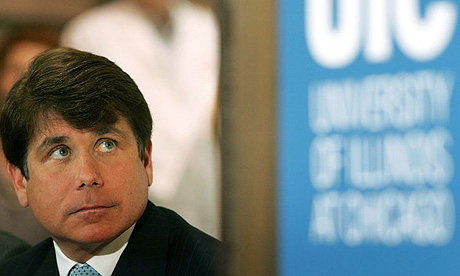
Students in my Introduction to American Law class know that the President of the United States may be removed from office if he is impeached by the House of Representatives and convicted by the Senate. In the House, impeachment requires a majority vote. In the Senate, conviction and removal must pass with 2/3 of the vote. Ever wonder how the chief executive officer of a state (a Governor) can be removed from office? Well, we may just be getting a lesson on this soon. Yesterday morning the Governor of Illinois (pictured) was arrested by the FBI on corruption charges; the main charge being that he was trying to fill President-elect Obama's Senate seat by choosing the person who gave him the most money. As an aside, the Illinois Constitution gives the Governor the power to fill a vacant U.S. Senate seat. In short, he was trying to sell the position formerly held by Obama. The Governor has not resigned, and from what I know of him, he probably will fight these charges to the bitter end. But the Illinois legislature does not have to wait to the end. They can remove him. According to the Illinois Constitution, the Governor can be removed via a process that is identical to the process used to remove the President. Just in case you were wondering.

09 December 2008

The Right to a Speedy Trial

Students in my Introduction to American Law class heard me say last week that the right to a speedy trial found in the U.S. Constitution is almost meaningless. I stand corrected, at least for the time being. Apparently, the Vermont Supreme Court recently ruled that a conviction had to be overturned and the defendant let free because he was not given a speedy trial. The case is currently pending before the U.S. Supreme Court, so my hunch is the right to a speedy trial will return to being meaningless once the Justices get through with this case.

05 December 2008

Hate Crimes Against Arabs Down

Students in my "Law and Social Change" class were treated this past Monday to a presentation on the war on terrorism in America. Part of the presentation addressed how Arabs and Muslims were impacted in the United States after September 11. According to the Arab-American Anti-Discrimination Committee, hate crimes incidents against Arabs and Muslims have been steadily decreasing since 2003. This should not be totally unexpected. As with all things related to September 11, the farther away we get from the attacks, the more reasonable the government and people seem to be in their responses to it.

02 December 2008

In God We Trust


or maybe I should say to God we give credit. At least that is what legislators in the State of Kentucky say must be part of the Kentucky Department of Office Security's annual report. According to the Associated Press:
The law that organized the Homeland Security office first lists Homeland Security's duty to recognize that government itself can't secure the state without God, even before mentioning other duties, which include distributing millions of dollars in federal grants and analyzing possible threats.
This seems to raise the same question that I ask myself every time I see an athlete praise God after a sporting event. If both teams ask for God's help with winning, do members of the losing team blame God for the loss? In the instance above, if God gets credit for securing the State of Kentucky, might he be blamed should something terrible happen there? Probably not. Instead the blame will be placed at the feet of "abortionists" gays and the ACLU. (follow the link and see quote number one if you are unsure what this means).

28 November 2008

Gay Marriage and Direct Democracy

Is the United States a direct democracy? Surely not, at least at the federal level. The President is not elected by "the people" but by an Electoral College. There is no ability for citizen referendum or other direct citizen input at the federal level. And judges are appointed by politicians for life. These are just a few features of the federal government that make it anything but a version of direct democracy. But many states, especially California, do have governments that make them look closer to a direct democracy. In California, citizens can amend their constitution by referendum. Their judges can be voted out of office at the end of their term by the people, and politicians (including judges) can be removed in the middle of their term by recall.

How this idea of direct citizen participation and individual rights co-exist could be put to the test soon in California. Last year the California Supreme Court ruled that laws banning gay marriage violated the California Constitution. In response, opponents of gay marriage were able to get an anti-gay marriage referendum on the ballot. This referendum, which a majority of voters supported in the recent November election, amends the Constitution to prohibit what the Supreme Court said had to be allowed under the Constitution: gay marriage.

So a showdown down between the court and the people appears to be on the horizon. Why? Because the California Supreme Court has agreed to review whether the people's amendment to the Constitution violates the Constitution. And so how have supporters of the people's amendment responded? By saying that they will try to recall any judge who votes to overturn the people's amendment. Confused?

Let's recap. The legislature banned gay marriage. The Court said the ban violated the Constitution. The people then amended the Constitution, overruling the Court. Now the Court is going to rule whether the people's action violates the Constitution. And if they do rule that way, the people are threatening to remove the judges. Simple. Which begs the question. Is democracy, as it is practiced in California, a good idea?

27 November 2008

Using Foreign Law

Courts in the United States are often criticized by some when they cite to foreign sources in their decisions. Supreme Court Justice Antonin Scalia is probably at the forefront of this anti-foreign law crusade, and he usually has much to say on the topic when given the opportunity. At a recent event in Houston, Scalia fretted that the U.S. Supreme Court will use foreign law in its decisions at an ever increasing pace. But is it such a bad thing to look at how courts in other jurisdictions deal with issues that are universal? Is this anti-foreign law crusade simply futile? Micheal Dorf at Findlaw has more.

Is Clinton Barred by the Constitution?

There is an interesting question floating around the blogesphere about whether Hillary Clinton is barred by the Constitution from accepting the Secretary of State nomination (a nomination which technically has yet to be made official). You see, Article I of the Constitution basically prohibits sitting members of Congress from taking new jobs in the government if the salary for that job has increased during the current term of the member of Congress. The Secretary of State's salary has indeed increased during Hillary Clinton's current term as U.S. Senator. But this is probably just an academic question. As bloggers over at the Ecomonist point out, it seems unlikely that Republican Senators, after years of watching the Bush Administration play fast and loose with constitutional rights, will hold up Hillary's nomination because of such an obscure part of the Constitution.

25 November 2008

Marriage Revisited

I have written in the past about the landmark decision of Loving v. Virginia in which the U.S. Supreme Court stuck down laws banning whites and blacks from marrying. I have also written about how the courts are becoming involved in the issue of gay marriage. But I have yet to suggest that these two cases raise the same issue, although I believe they may. Anna Quindlen of Newsweek has a nice short piece in this week's issue explaining how these cases are basically the same. Surprisingly, the question of whether this is a civil rights issue on par with issues raised by racial discrimination is somewhat controversial. And ironically polls show that a vast majority of African-Americans oppose gay marriage. So give this question some thought. Are laws prohibiting gay marriage the same as those which prohibited people of different races from marrying?

22 November 2008

The Minnesota Senate Race Recount


Students who have been paying attention to the aftermath of the recent election in the United States probably know that some races for the U.S. Senate and House of Representatives are still not decided. The Senate race in Minnesota is particularly interesting, as both candidates are challenging the validity of ballots cast by voters. How can this be, you might ask. Well, the Minnesota Public Radio website (this link will take you the pictures) has pictures of some of the ballots that are being challenged. It is fascinating. I encourage you to take a look.

16 November 2008

Can Congress Subpeona Bush as Former President?

What happens if the Democrat-controlled Congress wishes to order President Bush, once he becomes former-President Bush, to appear before a Congressional committee to answer for some of the things he did while President? It is clear that the idea of separation of powers in the Constitution precludes Congress from ordering a sitting President to appear. But a former President? The New York Times addressed this question a few days ago, and dragged out this quote from former President Harry Truman:

If the doctrine of separation of powers and the independence of the presidency is to have any validity at all, it must be equally applicable to a president after his term of office has expired,” Truman wrote to the committee.

Could it be that even former Presidents can exercise Executive Power? I see Truman's point, but could this apply equally to all of Bush's advisers? I have no doubt Bush would make this argument considering how expansively he has interpreted Executive Privilege.

14 November 2008

Next in Line

Most people know what happens if the President of the United States dies in office: the Vice-President becomes the President. But what happens if both become incapacitated at the same time? Better yet, what happens if many of the leaders in government are incapacitated at the same time. How deep does the Presidential line of succession go? The Wall Street Journal has an interesting piece in yesterday's paper about there very questions. In case you were wondering, federal law provides the order of succession:

1. President

2. Vice President

3. Speaker of the House

4. Senate President Pro Tem

5. Secretary of State

6. Secretary of the Treasury

7. Secretary of Defense

8. Attorney General

Of course, constitutional scholars believe this federal law is unconstitutional because the Constitution only talks about the Vice-President and then an officer (many believe this means member of the Cabinet) with regards to succession.

08 November 2008

Access to the Court

After a long break, postings to this blog are now resuming. And I'll start with a question raised by students in my "Debating Controversial Landmark Court Decisions" class. This question actually should be of interest to students in all my classes, be it English or law. The question: are television cameras allowed to film oral arguments in front of the U.S. Supreme Court? The answer: No. I actually wrote about this topic about a year ago, but a case is currently before the Court that has made me want to revisit this issue.

The case, Federal Communications Commission v. Fox Television Stations, concerns fines given out by the FCC to the Fox television network. The fines were were for "indecent" language on live television (here is one example from the Golden Globe Awards; at around 5:35 of the clip you can hear U2's Bono utter the "offensive" word).

In the lower courts, lawyers arguing in defense of Fox used the offending words as part of their arguments. One commentator described the arguments as being littered with the talk of seventh grade boys in a locker room. So as time drew near for oral arguments in front of the U.S. Supreme Court, commentators began to wonder whether Fox's attorney would dare to utter these words in front of the nine justices of the Supreme Court. So if televisions are not allowed in the courtroom, then what's the big deal?

Well, a few years ago the Court started allowing audio recordings of oral arguments to be released on the same day of the arguments. But in anticipation of this argument, Chief Justice Roberts has said the audio from this particular argument will not be available until the end of the term. This rather silly attempt to protect the public from naughty words was for naught. The lawyer for Fox decided against filling the hallowed chamber of the Court with F-words and S-words, so the audio of the arguments is "clean." Heaven forbid a few colorful terms be heard over the public airwaves or via mp3 download from the Court.

15 July 2008

Ages of U.S. Supreme Court Justices

Students of common law are always surprised to hear about how long members of the U.S. Supreme Court stay in their positions. After all, these are lifetime appointments and many Justices take this seriously. Here is a list of the current and their ages along with a list of the 10 most recent former Justices and their ages:

The members of the current Supreme Court, by age:

John Paul Stevens, 88
Ruth Bader Ginsburg, 75
Antonin Scalia, 72
Anthony Kennedy, 71
Stephen Breyer, 69
David Souter, 68
Clarence Thomas, 60
Samuel Alito, 58
John Roberts, 53

The last 10 justices to leave the Supreme Court, with their age and date of retirement:

Sandra Day O'Connor, 75, Jan. 31, 2006
William Rehnquist, 80, Sept. 3, 2005
Harry Blackmun, 85, Aug. 3, 1994
Byron White, 76, June 28, 1993
Thurgood Marshall, 83, Oct. 1, 1991
William Brennan, 84, July 20, 1990
Lewis Powell, 79, June 26, 1987
Warren Burger, 79, Sept. 26, 1986
Potter Stewart, 66, July 3, 1981
William Douglas, 77, Nov. 12, 1975

25 June 2008

Extending Presidential Privilege to the Limit

The words presidential privilege do not appear anywhere in the U.S. Constitution. Yet, the U.S. Supreme Court has consistently held that the President has the right to engage in confidential conversations with his advisers, unless these conversations concern potentially criminal activity. The Bush Administration has pushed the idea of privilege to unseen limits. First, they claimed that discussions between the Vice-President and his advisers could be shielded by presidential privilege, even if the President himself was not involved in the discussions. The U.S. Supreme Court agreed. Then they claimed that internal e-mails between the Attorney General and his advisers enjoyed presidential privilege protection. This remains an open question. And now the Administration is claiming that the privilege allows the President to withhold documents from a congressional investigation into whether he pressured the Environmental Protection Agency to weaken decisions on smog and greenhouse gases. At what point does this idea of privilege interfere with the basic principles of checks and balances contained within the Constitution?

23 June 2008

Puting the Cross on License Plates


The State of South Carolina will soon be offering a license plate to its drives with a Christian cross on it, as well as the words "I believe." Anyone who has been to the States might have noticed that one can find a variety of different license plates within a given state. While in Florida last year, I noticed license plates containing environmental themes ("protect our reefs" and "save the manatee"), sports themes (NASCAR, University of Florida, Florida State University) and family themes ("family first" or "family values"). click here for a complete list of Florida specialty license plates.

The question here isn't whether states can have specialty plates, but what happens when one of these specialty plates contains a message that may violate the Constitution. As students in both my classes this semester know, the First Amendment of the U.S. Constitution contains the Establish Clause, among other clauses. This clause has been interpreted by the Court to require some semblance of a separation of church and state. So when a state provides a license plate with an unmistakable Christian symbol on it, does this act violate the Establishment Clause? The courts will most surely be asked to decide this question in the near future.

18 June 2008

What Free Speech?

A few weeks ago 34 demonstrators were convicted of violating a law that prohibits holding demonstrations on the grounds of the U.S. Supreme Court. The question this obliviously raises is doesn't such a law violate the First Amendment right to free speech? The answer is probably not. Our discussion in class concerning freedom of speech has dealt mostly with something called "traditional public forums". These generally include streets, sidewalks and public parks. People have an almost unlimited right to engage in speech in this type of forum. But the courts have uniformly held that not all government property can be considered a traditional public forum. In fact, most government property is not considered a public forum and thus speech on this property can be regulated far easier.

Why make a distinction between a traditional public forum and other government property? Generally because the Courts have been sympathetic to the government's position that allowing speech on all government property in any manner would interfere with workings of the government. Imagine if the government had to allow protesters onto military bases or into prisons. Clearly, this kind of expressive activity would interfere with the ability of government to carry out it's mission, whatever that mission might be on the property in question. For purposes of this class, students don't need to know this distinction, but I hope it helps explain why these protesters, who entered the grounds of the Supreme Court, were arrested.

16 June 2008

Establishing Obscenity

The Tampa Tribune has a nice piece, which tries to explain how obscenity laws in the United States are enforced. The title of the article, Standards Of Obscenity Are Murky, says it all. As we discussed in Con Law class last week, trying to spot this form of non-speech is not easy. Unfortunately for a pornographer who calls himself Max Hardcore, a jury in Tampa recently was able to weed through this murky area of the law and find his films to be obscene. Which means Mr. Hardcore will soon be serving hard time for violating obscenity laws.

12 June 2008

Don't Ask, Don't Tell - An Update

During U.S. Constitutional law lecture a few weeks ago, I used the issue of gays in the military to illustrate how courts generally apply the rational basis test (as you recall, this is the lowest level of scrutiny applied to due process and equal protection claims). Well, it turns out that at least one court now believes that the military's policy of "Don't Ask, Don't Tell" should be judged using a level of scrutiny somewhere between strict and rational basis. Here's why.

A few years ago the U.S. Supreme Court struck down a Texas statute that outlawed consensual homosexual sex. (see Lawrence v. Texas). According to many commentators, and three judges on the First Circuit Court of Appeals, the decision in Lawrence recognized "a protected liberty interest for adults to engage in private, consensual sexual intimacy and applied a balancing of constitutional interests that defies either the strict scrutiny or rational basis label." In short, the Court didn't use the rational basis test to deal with this law that classified gays and lesbians differently then heterosexual couples, which is how courts had always dealt with such classifications in the past.

But even using this "new" level of scrutiny that falls between strict scrutiny and rational basis, the First Circuit Court of Appeals still found the Don't Ask, Don't Tell policy to be constitutional. How?

The court began it's analysis by noting that "Lawrence balanced the strength of the state's asserted interest in prohibiting immoral conduct against the degree of intrusion into the petitioners' private sexual life caused by the statute in order to determine whether the law was unconstitutionally applied." In short, the Lawrence Court weighed the "protected liberty interest" as noted above, against the state's interest in stopping "immoral conduct." In the end, the Lawrence Court felt that individual right was more important.

Lawrence truly was a departure from past reviews of laws that classified gays and lesbians differently, i.e. using the rational basis test. A rational basis analysis "does not permit consideration of the strength of the individual's interest or the extent of the intrusion on that interest caused by the law; the focus is entirely on the rationality of the state's reason for enacting the law," said the First Circuit Court of Appeals. In Lawrence, the Court most certainly looked at the individual interest at stake.

So the First Circuit Court of Appeals now had to use this new approach to judge the military policy at issue. And they did so rather quickly, saying basically that when it comes to matters of the military, courts have always shown deference to Congress because: 1) Congress is in a much better position than the courts to determine the proper workings of the military and; 2) the U.S. Constitution specifically gives Congress the power to raise and support armed forces. The Court then noted that the policy in question was created after a careful and thorough review noting that Congress:
focused explicitly on the effect that the Act could have on constitutional rights of homosexuals, concluding that "if the Supreme Court should reverse its ruling in Bowers and hold that private consensual homosexual acts between adults may not be prosecuted in civilian society, this would not alter the committee's judgment as to the effect of homosexual conduct in the armed forces. . . . Congress ultimately concluded that the voluminous evidentiary record supported adopting a policy of separating certain homosexuals from military service to preserve the "high morale, good order and discipline, and unit cohesion" of the troops.
In short, concerning matters of the military, courts should basically defer to Congress, which is really what Courts generally do when applying the rational basis test. Which begs the question. Did the First Circuit really use something other than the rational basis test in concluding that the policy did not violate the Constitution? It doesn't appear so.

11 June 2008

How Not to Conduct a Jury Trial

Students learning about common law sometimes question whether the jury system is an efficient and just way to run a legal system. News out of Sydney, Australia may support the proposition that in fact jury trials are a waste of time, not to mention a waste of money. At least this particular trial was. Yesterday a judge presiding over a three-month-long jury trial that cost the state over a $1 million dismissed the jury before they could reach a verdict because it was discovered that at least four members of the jury spent a good deal of time in the jury box playing Sudoku when they should have been paying attention to the trial. There is no law prohibiting jurors from being inattentive, even if the inattentiveness results in the judge ordering a retrial. Apparently, officials in the state of New South Wales are considering a rewrite of their jury rules that would, at the very least, prohibit jurors from playing games while sitting in the jury box. Probably not a bad idea.

10 June 2008

Enforcing Medical Marijuana Laws

One of the more important recently decided Commerce Clause cases dealt with whether the federal government could enforce federal anti-drugs in California after voters there decided to legalize marijuana for medicinal purposes. (see Raich v. Gonzalez) The answer given by the U.S. Supreme Court was yes, the Feds can arrest people for using marijuana even if users are doing so pursuant to California state law. The question many students must have is: so is it still legal to purchase marijuana in California, under state law, for medicinal purposes? The quick answer is under state law YES, but people who use the drug still run the risk of being arrested by federal agents under federal law. But it gets even more confusing. The San Diego Union-Tribune newspaper recently reported that San Diego County is suing the State of California to repeal the medical marijuana laws. Lawyers for San Diego and San Bernardino counties will argue that the state cannot force counties to issue identification cards to qualified medical marijuana patients because the drug is illegal under federal law.

So, under California law it is the local government (in this case county government) that must help carry out the medical marijuana law, but the counties are beginning to question whether this is wise (and lawful) in light of the aforementioned U.S. Supreme Court decision. Ah, the joys of federalism.

UPDATE - A California court has ruled that California's medical marijuana laws do not violate federal law saying, "The purpose of the (federal law) is to combat recreational drug use, not to regulate a state's medical practices." It is possible that this ruling will be appealed to California Supreme Court.

09 June 2008

Interpreting State Constitutions

As has been noted on several occasions in American Constitutional Law class, an individual state may grant more rights to people under it's constitution than are available under the federal constitution. But there may also be instances where a state constitution places more limitations government. For instance, the United States Supreme Court has held the giving parents vouchers (money) to help pay for tuition charged by religious schools did not violate the Establishment Clause found in the First Amendment of the U.S. Constitution. But many states, including Arizona, have a clause in their constitution that specifically prohibits state money from being used in any manner related to religion. So it was no surprise that the Arizona Supreme Court recently ruled that school vouchers given out by the State of Arizona violated the Arizona constitution. So, to review, the U.S. Supreme Court said this practice does not violate the U.S. Constitution, but the Arizona Supreme Court said that it DID violate the Arizona constitution. Federalism in the U.S. isn't always easy to comprehend.

03 June 2008

Picking Judges

Students of American Constitutional Law are by now quite familiar with how federal judges are selected. Thus, it goes without saying that the upcoming President election is important not only because it will determine who the next leader of America is, but is also important because it will likely determine whether the U.S. Supreme Court becomes more liberal or conservative. Syndicated columnist Linda Chavez, with whom I rarely agree, has an interesting article arguing why the issue of judicial nominations should be, but is not, an important criteria for selecting the next President.

16 May 2008

States' Rights

By now students in my Constitutional Law class are quite familiar with the federal system of government in the United States. But I cannot emphasize enough the fact that the fundamental rights contained in the Constitution and its Amendments represent the bare minimum of rights enjoyed by residents of the United States.

What do I mean by that? Simple. Government cannot violate these rights. Period. But governments (state and federal) may provide greater rights. How so? A case decided by the California Supreme Court yesterday provides a nice illustration.

The U.S. Congress is on record saying that marriage can only be between a man and woman. Federal courts have generally ruled that this limitation does not violate the U.S. Constitution (although the U.S. Supreme Court has never weighed in on this question). But several states have decided that under their own constitutions, the right to marry is extended to couples of the same sex.

By a 4 to 3 vote, the California Supreme Court said that a California law restricting marriage to only couples of the opposite sex violates the California Constitution. By doing so, the California Court is providing greater rights to gays and lesbians then what is given to them under the U.S. Constitution. In short, the U.S. Constitution sets a floor of rights under which government may not go. But if government decides to provide greater rights, that's fine as there is no ceiling set by the U.S. Constitution when it comes to the states granting fundamental rights under their own constitutions.

14 May 2008

War Power

As we discussed last week, the Constitution sets up the potential for conflict between Congress and President when American troops are sent overseas and placed in harms way. Article I clearly gives Congress the power to declare war, but Article II makes the President Commander-in-Chief, which inherently gives him the power to defend the United States without obtaining approval from Congress. Presidents have defined "defend" rather broadly, dispatching troops to places like Panama and Beirut and putting them in war-like situations without getting approval from Congress. I just came across a piece on the English Deutsche Welle site about a case that many of you probably are already aware of. It seems that the German Constitutional Court has settled this question about who has the power in Germany to dispatch troops to foreign soil. Any deployment of German troops to foreign soil must be done with the approval of the Bundestag, so said the Court. There are a number of reasons why it was easier for the German Court to deal with this issue then it would be for the U.S. Supreme Court. For starters, there is much clearer division of power between branches in the United States. Second, as a rule the Supreme Court does not answer "political questions." More on that next week.

09 May 2008

No to German National Security Council

In case you missed it, German Foreign Minister Frank Walter Steinmeier has rejected an idea put forth by Chancellor Merkel for the creation of a U.S.-style National Security Council. As you will recall from our last Constitutional Law lecture, the NSC was set up to counsel the President concerning relations with foreign countries. It's no wonder why Herr Steinmeier would oppose such a move. American Secretaries of State (the equivalent of the German Foreign Minister) have generally had cool relations with the NSC. And why wouldn't they? The NSC is basically serving a similar role as the Secretary of State, meaning the Secretary has competition for the President's attention on matters of foreign relations.