 Jurists in both America and Great Britain are struggling with whether to allow television cameras into its highest courts. In the U.S., each state has dealt with this question differently; some letting camera into their courtrooms others not. But the federal courts still are a bit camera shy. Questions such as fairness to the parties and whether allowing cameras in will turn the court process into a circus are part of this often heated debate. In Britain, where the court system is undergoing enormous changes, especially at the very highest level with the creation of a new Supreme Court, the question is whether viewers should be allowed to watch Supreme Court proceedings on TV. Obviously, these proceedings are open to the public, i.e. one can go to the courtroom and watch it. Furthermore, other political proceedings are already televised in both Britain and the United States. But some judges aren't buying it. Recently, U.S. Supreme Court Chief Justice John Roberts expressed concern that the camera's in the courtroom would undermine the workings of the Court. However, in Britain it appears that many top judges have no trouble with having their work televised.
21 November 2007
Court TV
Jurists in both America and Great Britain are struggling with whether to allow television cameras into its highest courts. In the U.S., each state has dealt with this question differently; some letting camera into their courtrooms others not. But the federal courts still are a bit camera shy. Questions such as fairness to the parties and whether allowing cameras in will turn the court process into a circus are part of this often heated debate. In Britain, where the court system is undergoing enormous changes, especially at the very highest level with the creation of a new Supreme Court, the question is whether viewers should be allowed to watch Supreme Court proceedings on TV. Obviously, these proceedings are open to the public, i.e. one can go to the courtroom and watch it. Furthermore, other political proceedings are already televised in both Britain and the United States. But some judges aren't buying it. Recently, U.S. Supreme Court Chief Justice John Roberts expressed concern that the camera's in the courtroom would undermine the workings of the Court. However, in Britain it appears that many top judges have no trouble with having their work televised.

20 November 2007
Then v. Than
Knowing when to use "then" or "than" isn't one of the recurring problems I see in students' writing. Nevertheless, it's always helpful to receive a little refresher and the WikiHow How-to-Manual has a short little piece that may be of assistance.
13 November 2007
Policing Judges
As students of Common Law Legal System in Münster and Institutionen von Staat und Gesellschaft in Osnabrück learn, judges in common law countries, especially in the United States and England, are quite powerful. Many are appointed for life terms (in England, a life term means until the judge turns 70 years-old) and few ever face the threat of discipline, even for the most outrageous of acts. Every so often, however, one comes across a story about a judge who has gone too far. One such story surfaced this past week in Virginia, where a state court judge was removed from the bench for extreme behavior. In this particular case the judge had done things like decide a child custody case by flipping a coin (Münze werfen) and ask a female to take off her pants in court. It's rare that judges get disciplined. So rare that when they do, it's newsworthy.
07 November 2007
Judges for Sale

Many states in America select their judges through an open election process. Thus, judges run for the post of judge just as any other politician runs for office. The upside? Judges become accountable to voters. The downside, and there are many? Judges, like other politicians in America, become reliant on campaign contributions. There are two interesting pieces in yesterday's USA Today highlighting the importance of money in the process of electing judges. One piece, written by someone in support of trial lawyers giving campaign contributions to judges makes the argument that if big business interests are giving money to judges, trial lawyers have no choice but to match those contributions in the hope of being able to equally influence judges. A sad commentary on this method of choosing judges, really. The other piece, I think, nicely points out the flaws of this system. Both pieces provide a nice understanding of the problems with electing judges in America.
05 November 2007
Wallach: Waterboarding Used to Be a Crime
Students in Münster have the privilege of selecting from a wide range of elective courses during their final two semesters of the FFA. One class offered every winter semester is The Law of War, taught by U.S. Federal Judge Evan Wallach. I've sat in on this class before and I can tell you that it is both timely and fascinating. As a federal judge, Judge Wallach likely feels somewhat constrained as to what he can say about the current "war on terror" being conducted by the Bush Administration. That's what makes his opinion piece that appeared in yesterday's Washington Post extraordinary. As I wrote last week, the issue of whether an interrogation technique called waterboarding is torture has been the focus of the U.S. Attorney General nomination hearings currently taking place in Washington D.C.. Judge Wallach weighs in on this debate with an emphatic YES.
02 November 2007
Press Freedom at Risk . . . in Germany!
In American Constitutional Law we learn about the central role that freedom of the press has played in the development of the American constitutional democracy. It goes without saying that press freedom is essential to any democracy. Which is why some of the measures taken by governments after the September 11 attacks in America are troubling. Der Spiegel has an interesting article on how the German government is joining the ranks of countries who are jeopardizing press freedom as part of the "war on terror."
31 October 2007
Torture and the Appointment Process
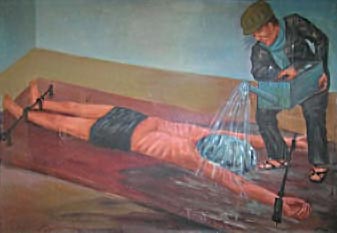 Students of American Constitutional Law learn that the U.S. President has the power to appoint the government's chief law enforcement officer, the Attorney General. Students also know that while the President has the power to appoint, he must also receive the consent of the United States Senate. This nomination process has been playing itself out in Washington D.C. over the past few weeks with President Bush's nominee for Attorney General, former federal judge Michael Mukasey (link to Spiegel article in German), appearing several times before a committee of Senators who are responsible for determining whether the nominee is "qualified." If you have been following this process, which is somewhat unlikely because the German media has not been following it, the central question concerning whether Judge Mukasey should be approved as the new AG is whether he believes something called waterboarding is torture. Seems odd that the process should boil down to this one question, and even odder that Judge Mukasey refuses to give his position on it. So what is waterboarding, you might ask? There was a great piece posted yesterday on the Foreign Policy Magazine blog quoting a person who is very familiar with how the waterboarding technique works. Follow the link below and judge for yourself whether this technique is torture and then ask yourself, why won't Judge Mukasey simply tell the Senators that this technique is indeed torture.
30 October 2007
The Joke's on Him
Did you hear the joke about the American lawyer who sued a dry cleaner for $54 million because the dry cleaner lost a pair of pants he brought in for $10.50 worth of alterations? Okay, as you probably know it was not a joke. An actual lawyer filed a real lawsuit in Washington D.C. earlier this year over missing pants. And yes the amount claimed in damages was $54 million. The lawsuit was rightfully dismissed, but the damage had been done. This case, and many others, keep the stereotype that many Germans have of Americans as being litigation happy alive and well. According to this stereotype, Americans will sue over just about anything (being served coffee that is "too hot," getting sick from smoking cigarettes or eating fast food, etc.). As I will point out in later posts, while the stereotype of Americans may be fair, it's not limited just to Americans. But back to the dry cleaner lawsuit. You may remember that the lawyer who filed the suit was also an administrative law judge. Well not for much longer, according to the Washington Post.
26 October 2007
More on el-Masri
Earlier this week I mentioned the case of Khaled el-Masri and how the U.S. Supreme Court has basically told him that he has no remedy for being wrongly abducted and held by U.S. authorities. Spiegel Online has a nice summary of the Court's decision in both German and English. It's worth read in whatever language you choose. The title of the piece Security Trumps Liberty says it all.
25 October 2007
Access to Justice

There is an access to justice problem in Canada, according the country's top judge. The issue, which is not unique to Canada, is the cost of going to court to seek redress for a wrong. According to a recent Toronto Star report, the cost of a routine three-day civil trial in Ontario is about $60,000, more than the median Canadian family income. The Star reports:
In a speech to the Canadian Bar Association yesterday, the country's top judge declared access to justice "a basic right" for Canadians, like education or health care. Although [Chief Justice Beverely] McLachlin has spoken out about the problem in the past, she sharpened her remarks yesterday and went further than she has before, citing what she described as an "increasingly urgent situation." The justice system risks losing the confidence of the public when "wealthy corporations," or the poor, who qualify for legal aid, have the means to use the court system, she said, noting that for "middle-class" Canadians, resolving a legal problem of any significance often requires taking out a second mortgage or draining their life savings.Others have argued that the problem is "money grubbing" lawyers who are charging excessive fees and lack principles.
24 October 2007
More to Come
And yet another semester begins.
Since I last wrote, the branches of the U.S. government have been struggling with how much power the government should have to intercept electronic communication of suspected terrorists. Yet, with the U.S. Supreme Court's recent refusal to hear the case of Khaled el-Masri (a case of particular interest to Germans because el-Masri is a German) and the President's refusal to turn over documents to Congress related to his powerful surveillance program, it appears that the struggle is far from over. But this is really a constitutional law question, and that was last semester. So what's new in the news concerning classes being held this semester? A lot! Over the course of this semester, I will be posting items related to our discussions in class as a way of illustrating that the theory we discuss in class is related to everyday current events taking place in common law countries. Check back regularly.
Since I last wrote, the branches of the U.S. government have been struggling with how much power the government should have to intercept electronic communication of suspected terrorists. Yet, with the U.S. Supreme Court's recent refusal to hear the case of Khaled el-Masri (a case of particular interest to Germans because el-Masri is a German) and the President's refusal to turn over documents to Congress related to his powerful surveillance program, it appears that the struggle is far from over. But this is really a constitutional law question, and that was last semester. So what's new in the news concerning classes being held this semester? A lot! Over the course of this semester, I will be posting items related to our discussions in class as a way of illustrating that the theory we discuss in class is related to everyday current events taking place in common law countries. Check back regularly.
06 July 2007
Another Semester Break
I won't be posting during break. I'll resume posting at the start of next semester. Have a nice break!
03 July 2007
An interesting piece was posted on the Slate Magazine website a few days ago entitled "How to Keep Brown Alive." As I noted in my last post, the Supreme Court has made it clear that race cannot be used as a factor in assigning students to schools; even if the classification is aimed at creating racial diversity. The Court held that the government could not meet the strict scrutiny test, which it is required to do for race-based classifications. So does this mean that the legacy of Brown v. Board of Education is dead? No says Richard Kahlenberg over at Slate. How about using wealth as a factor in assigning kids to schools? Kahlenberg notes that some 40 school districts are already using plans that assign kids to schools using wealth as a factor. He notes that these policies actually result in very diverse schools . . . even from the stand point of race.
Would such a classification survive Court scrutiny? Possibly. Classifications based upon wealth would be subject to the rational basis test, which as we discussed in class is a far easier hurdle for the government to clear. The goal of having diverse schools would likely be considered a legitimate government interest and using a wealth classification to achieve this goal would likely be deemed reasonably related to the goal. But could this classification still be challenged as being a race-based classification? Possibly. It is likely that white students would claim that this wealth classification is nothing more than a disguise for a race-based classification. Furthermore, these students could probably show that many of these policies were created to get around the recent Supreme Court ban on race-based classifications for assigning students to schools. So both effect and purpose could possibly be shown.
Would such a classification survive Court scrutiny? Possibly. Classifications based upon wealth would be subject to the rational basis test, which as we discussed in class is a far easier hurdle for the government to clear. The goal of having diverse schools would likely be considered a legitimate government interest and using a wealth classification to achieve this goal would likely be deemed reasonably related to the goal. But could this classification still be challenged as being a race-based classification? Possibly. It is likely that white students would claim that this wealth classification is nothing more than a disguise for a race-based classification. Furthermore, these students could probably show that many of these policies were created to get around the recent Supreme Court ban on race-based classifications for assigning students to schools. So both effect and purpose could possibly be shown.
29 June 2007
Another Controversial Finish
The United States Supreme Court finished its 2006-2007 term this week with a bang. As I mentioned last week, the Court still had some rather controversial cases left to decided as it entered its last week of session. The court did not disappoint . . . at least when it came to creating a controversy. The week started off with the Court holding that students do not have the right to engage in speech that contradicts a school policy against illegal activity. The policy in question was a school's anti-drug policy. The speech in question was a sign with the words "Bong Hits for Jesus" on it. In a 5-4 decision, the majority of the Court concluded that schools have the right to restrict student speech that advocates illegal behavior. In this case, a majority of the Court concluded that the sign was a pro-drug message, even if the student who created the sign didn't intend it to be. Many legal scholars see this as a narrow ruling, but at least three justices on the Court appear to be willing to give schools significantly more power to restrict student speech.
The Court's final decision, handed down yesterday, was every bit as controversial, if not more. The Court, in another 5-4 decision, struck down school policies that used race as a deciding factor in determining where a student would attend school. At issue was a policy intended to create racial balance in schools that resulted in students being bused across town to achieve this racial balance. This scheme had its origins in the landmark Brown v. Board of Education decision, which said that separate schools for blacks and whites could never be equal. While the Court ruling yesterday doesn't overturn Brown or cases that allow for affirmative action, it seems to severely limit government's ability to create diversity by using race as a factor. The Court basically said that the policy in question was not necessary to serve the states compelling interest. What other means the state could have used to create racial balance in its schools is left unsaid by the majority of the Court. The dissenters, on the other hand, claim the majority ignored past precedent and basically overturned past precedent without expressly doing so. This decision appears to be part of a larger strategy to limit the reach of past precedent that many conservatives believe were incorrectly decided, without actually overruling the precedent.
Interesting times at the United States Supreme Court and surely proof that the judicial appointments made by President Bush two years ago have made an enormous impact on the direction of the Court.
24 June 2007
The Final Eight
Entering it's last week of 2006-2007 term, the United States Supreme Court still has eight cases left to decide. And as usual, they are some of the most controversial cases on the docket. Students in my Conversation and Presentation Skills class know that the court is trying to figure out whether a student can be punished for holding up a sign saying "Bong Hits for Jesus" at an event held outside of the school. This case has the potential of redefining how the court deals with the free speech rights of students. But some of the other cases left to decide are equally interesting. For instance, the Court must still determine whether schools can take race into account when assigning students to schools in a given school district. The practice has been used for decades to make sure there is some kind of racial balance in schools. As students in my Constitutional classes know, the issue how race classifications operate under the Equal Protection Clause has been controversial since the adoption of the 14th Amendment to the Constitution. Also still on the undecided list is a case dealing with the death penalty and mentally ill defendants, as well as the ability to bring Establishment Clause challenges, as the Court looks at what kind of "harm" one must show to be a plaintiff in a challenge based upon the Establishment Clause. The issues involved in these cases touch upon some of the most hotly debated issues in America, and many people are anxiously awaiting this last week of Court decisions.
18 June 2007
Electing Judges
The New York Times has an interesting piece on a new study looking into the impact of campaign financing on judicial election campaigns. The study found that an average of $244,000 was spent on each judicial campaign. That's the average. You can be sure the campaigns for state supreme courts cost much more. Take Alabama's Supreme Court race for instance. According to the Times, the Alabama contest was the second most expensive in the history of the nation, with over 17,000 radio and televisions being run throughout the state during the campaing. 17,000! Take a look at the article for interesting facts on spending in judicial campaigns.
13 June 2007
Symbols Aren't Always Speech
 American Constitutional Law students learn that symbols are also considered speech that is protected by the Constitution's First Amendment. But one must be careful when dealing with symbols, as a biker club in California recently found out. For symbols to be speech they must communicate a reasonably understandable message. What does this mean exactly? Well for starters the person wearing the symbol must intend the symbol to express a thought or idea. Second, a reasonable person must be able to at least remotely understand the message being expressed.
A recent case in California, we will call it the California biker case, dealt with a prohibition of motorcycle club insignia and gang colors at something called the Gilroy Garlic Fair. The bikers in question wore a club symbol (pictured above) showing a skull, wings and a top hat; and were forced to leave the fair for violating the fair's aforementioned policy. They sued claiming the club symbol was speech protected by the First Amendment. They lost because not even the members of the biker club could agree on what the symbol meant. The court reasoned that if the bikers themselves didn't know what message was being expressed by wearing the symbol then how could the symbol be speech.
12 June 2007
40 Years Ago Today
It was forty years ago today that the United States Supreme Court struck down laws banning blacks and whites from marrying. The now famous Loving v. Virginia case was brought on behalf of an interracial couple who were thrown in jail for violating Virginia law. They were eventually forced to move from the state until the Supreme Court finally stepped in to say that the practice of banning interracial marriages, which was still law in 17 states at the time, violated the Constitution's Equal Protection Clause. The Associated Press has a fascinating short piece on the history of the case. It's worth a read.
05 June 2007
Independent Judges
There is a fierce debate currently being waged in the United States over how independent judges should be. As students of common law learn, the common law judge both interprets law and makes law. But there is a clear distinction between the two. When the legislature or constitution speaks to an issue, it the judge's job to interpret what the law or provision means. So what happens when judges, while interpreting law, end up doing so in such a way that actually looks more like lawmaking? In America, there is a movement to limit the ability of judges to interpret law in a manner that is inconsistent with the intent of the drafters of the law or the Constitution. But some "legal heavywieghts" are weighing in on this issue opposing efforts to place constraints on judges. One such advocate of "judicial independence" is retired Supreme Court Justice Sandra Day O'Connor, who recently gave a speech at the University of Tulsa on this issue. O'Connor's comments in the Tulsa World are worth a look.
03 June 2007
Separation of Church and State
 In our Constitutional Law class we will soon be discussing the religion clauses of the First Amendment. One of the more controversial interpretations of the First Amendment's Establishment Clause is that government and religion should be separate, or as Thomas Jefferson wrote, there should be "a wall separating church and state." The are many arguments in support of this interpretation of the Establishment Clause, but the one that is most convincing to me is that we should not allow government and religion to mix because America is a religiously diverse country and some religions will be given an advantage over others. For instance, if we allow prayer in public school, whose prayer should we allow? Christian? Jewish? Muslim? Hindu? If we simply allow the majority to decide then surely those practicing a minority religion will feel left out.
A nice illustration of this is currently being debated in Indonesia, which is predominately Muslim, but also has majority Christian areas. Many areas within Indonesia base their laws upon the Koran, also known as Sharia law. For instance, in some parts of the country all women, even those who are not Muslim, must abide by the Sharia law dress code for women. In response to this, politicians in a Christian area of the country are proposing basing their laws on the Bible. But is this really the best way for a diverse country to operate? Is it preferable to have a patchwork of relgious based laws across the country? Or is the better solution to simply keep religion and government separate, as Thomas Jefferson proposed at the birth of the United States.
Subscribe to:
Posts (Atom)